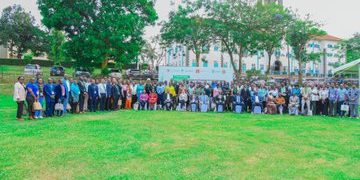



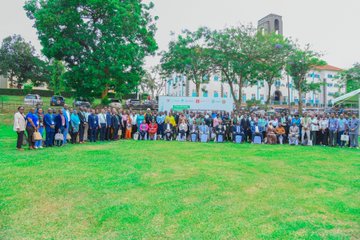
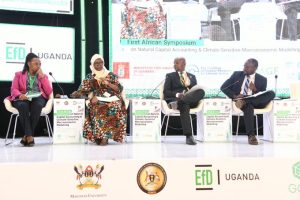
Kampala— Makerere University has successfully concluded the First African Symposium on Natural Capital Accounting and Climate-Sensitive Macroeconomic Modelling, a landmark continental gathering aimed at strengthening Africa’s ability to integrate climate and natural capital issues into economic and fiscal decision-making.
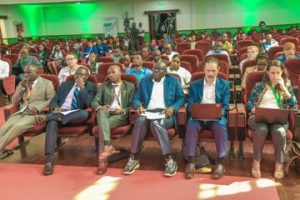
Held under the theme “Climate-Sensitive Macroeconomics: Rethinking Growth in Africa’s Natural Resource,” the two-day symposium attracted policymakers, researchers, universities, think tanks, development partners, and media representatives. Participants called for deeper collaboration between research institutions and policymakers to ensure sustainable development in Africa.
The event was officially opened by Hon. Henry Musasizi, Minister of State for Finance (General Duties), who was joined by Hon. Beatrice Anywar Atim, State Minister for Environment. Organisers noted that the symposium was designed to strengthen Africa’s analytical and institutional capacity, ensuring that climate risks and natural resource depletion are fully reflected in national planning, macroeconomic modelling, and fiscal policy frameworks.
Call for Research That Impacts Policy
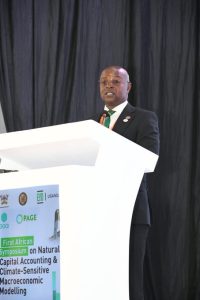
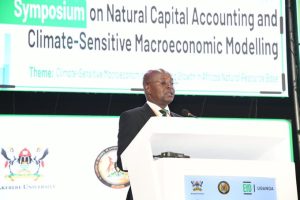
Speaking at the symposium, Prof. Edward Bbaale, the Principal, College of Business and Management Sciences, emphasised the need for stronger institutional coalitions and knowledge-sharing across Africa.
“We are doing research, and we developed a Natural Capital Accounting model and developed a short course. We are involved in the NCA processes, and we are engaging the relevant MDAs. We are writing fiscal policy briefs on existing NCA accounts,” Prof. Bbaale said.
He added that Makerere is already expanding its academic offerings to respond to Africa’s emerging climate governance needs. “We are looking at integrating natural capital and climate into modelling, and many other short coursesare already part of our menu. We partner, but Africa is looking at its uniqueness,” he explained.
Prof. Bbaale further stressed the importance of collaboration across institutions. “We want to partner with other ministries, universities, and other think tanks and have a feedback relationship. We want this to be furthered,” he noted.
Climate Policy is a Governance Challenge
Prof. Bbaale highlighted that bridging the gap between climate research and policymaking is not purely technical, but a governance challenge. “Bridging the gap between climate science and policy is not merely a technical task — it is a governance challenge that requires structured collaboration between researchers and decision-makers,” he said.
Finance Ministry Integrates Climate into Macroeconomic Models
Dr Albert Musisi, Commissioner for Macroeconomic Policy at the Ministry of Finance, explained that Uganda is increasingly prioritising climate-sensitive planning due to its high vulnerability to climate shocks.
“There is a need to build capacity in climate-sensitive macroeconomic modelling. We are integrating climate change into macro models,” Dr Musisi said.
He noted that Uganda’s planning must incorporate both climate mitigation and adaptation strategies. “We need to combine mitigation and adaptation in our work,” he said.
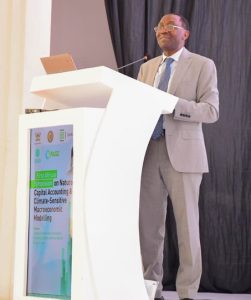
Dr Musisi added that climate change has already affected Uganda’s economic growth, prompting the government to strengthen its modelling systems. “Our growth was being affected by climate change, which wasn’t being captured, and we decided to capture this into our integrated model. We are extending the social accounting matrix to fit in our IMEM,” he explained.
The commissioner also called for greater collaboration with universities and partners to build local modelling capacity. “We have not yet been able to conclude, and that’s why we need to collaborate with Makerere and other partners. We are using external models. We need a framework to bring in all issues to do with mitigation and adaptation,” Dr Musisi said.
He added that Uganda is now incorporating climate financing into its planning frameworks.
“Uganda has higher vulnerability to climate change shocks and lower scores for readiness to respond compared to peer states in East Africa. This is why the Ministry of Finance is now incorporating climate change into its macroeconomic planning,” he said. “What we are now doing is incorporating climate financing in all our plans,” he added.
Experts Urge Climate Research That Shapes Policy and Investment
Dr Ibrahim Mike Okumu, Associate Professor and Dean at Makerere University School of Economics, emphasised that climate research should go beyond theory to directly influence investment and policy.
“The question before us is not whether climate-research matters but how it shapes policy and investment decisions,” Okumu said.
He acknowledged that Uganda is making progress in climate budgeting, while natural capital accounting remains a work in progress.
“In Ugandan initiatives such as climate budgeting, signal progress. Natural Capital Accounting remains a work in progress. Climate change demands research in local capacity. Advancing macroeconomic modelling is essential for sustainability,” he said.
Development Partners Applaud Makerere’s Leadership
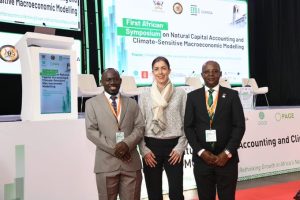
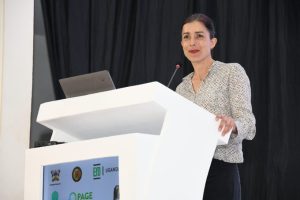
Amrei Horstbrink, from the United Nations Partnership for Action on Green Economy (PAGE), commended Makerere University and its partners for advancing climate governance. She emphasised the importance of translating academic research into measurable policy impact.
Meanwhile, Prof. Heinrich Bohlmann of the University of Pretoria highlighted gaps in economics curricula across Africa. “Economy-wide system thinking is key when evaluating climate shocks and policy responses, however, these remain largely absent from most economics curriculums. More training for both teachers and students are required,” he said.
Way Forward
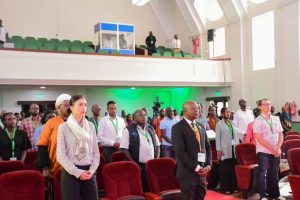
The symposium concluded with calls for African governments and academic institutions to strengthen institutional frameworks, invest in climate modelling skills, and develop locally-driven research that shapes fiscal policy.
Participants urged universities to introduce short courses in climate change and macroeconomic modelling and to work closely with ministries and development partners to translate research into tangible policy reforms.