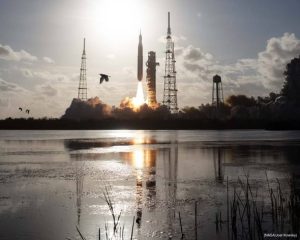




The United States has successfully concluded the landmark Artemis II mission, with the crew safely returning to Earth after completing a historic 10-day journey around the Moon.
The mission, led by the National Aeronautics and Space Administration (NASA), saw astronauts Reid Wiseman, Victor Glover, Christina Koch, and Jeremy Hansen splash down in the Pacific Ocean near San Diego at 8:07 p.m. Eastern Time on Friday, April 10, 2026.
The mission marks the first time in more than 50 years that humans have travelled around the Moon, representing a major milestone in deep space exploration and international scientific cooperation.

The U.S. Embassy in Uganda welcomed the successful return of the crew, describing the mission as a breakthrough moment for global innovation and space science.
“The #ArtemisII mission marks a significant milestone in global space exploration and innovation. It underscores the importance of sustained investment in science, technology, and research,” the Embassy said in a statement shared on social media.
NASA confirmed that the spacecraft completed its splashdown safely and that all four astronauts are in good health following recovery operations. The crew’s journey took them farther into space than humans have travelled in decades, testing systems and procedures critical for future lunar and Mars missions.

NASA officials described the mission as a foundational step in the broader Artemis programme, which aims to return humans to the Moon and eventually establish long-term exploration capabilities beyond Earth orbit.
The successful completion of Artemis II has been widely celebrated by space agencies and diplomatic missions around the world, highlighting renewed global interest in lunar exploration and scientific advancement.
With the crew now safely back on Earth, attention shifts to the next phase of the Artemis programme, which is expected to build on the mission’s findings and further prepare humanity for deep space exploration.