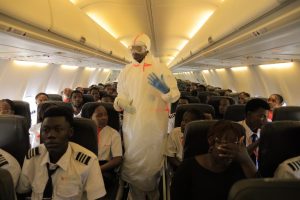



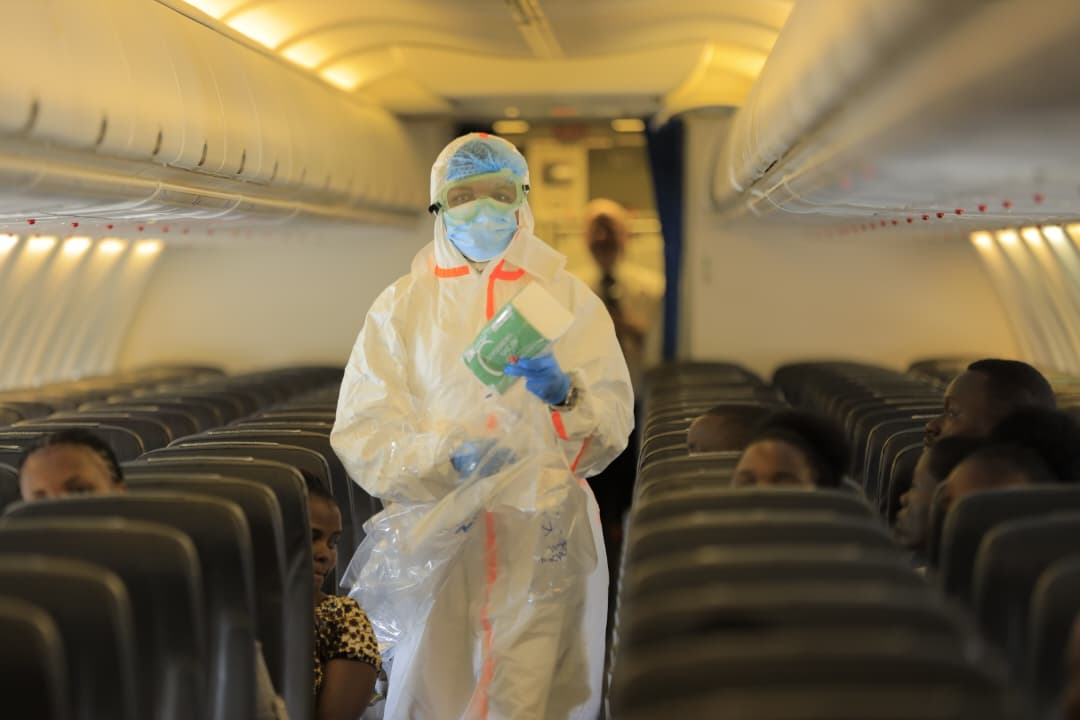
ENTEBBE — Entebbe International Airport has conducted its first dedicated public health emergency preparedness exercise, simulating an infectious disease outbreak aboard a Uganda Airlines flight to test the airport’s ability to detect and contain potential health threats.
The full-scale exercise was conducted on Monday, November 23, 2026, by the Uganda Civil Aviation Authority (UCAA) in collaboration with the Ministry of Health, Uganda Airlines and other airport stakeholders.
UCAA Director General Fred Bamwesigye said the simulation was designed to assess the airport’s preparedness, response capabilities and coordination mechanisms in managing public health emergencies, particularly outbreaks of infectious diseases that could threaten international travel.
The simulated scenario involved a Uganda Airlines aircraft arriving at Entebbe with 76 passengers and five crew members. The crew reported a suspected infectious disease case on board to Air Traffic Control.

Of the 76 passengers, 25 were presumed to have come into contact with the suspected case, while 55 had no direct contact. Nineteen of those without direct contact were transit passengers.
The exercise tested the ability of aviation personnel, health workers, security agencies and other stakeholders to identify, isolate, assess and manage suspected cases while maintaining normal airport operations.
Bamwesigye said the exercise also assessed compliance with infection prevention and control measures, including the proper wearing and removal of personal protective equipment.
It was also intended to strengthen coordination among participating agencies, clarify their responsibilities and reporting lines, and improve the ability of aviation personnel and Port Health teams to detect and respond promptly to public health threats.

“Such incidents do not always give us warning. The only way we can respond appropriately is by continuously simulating emergencies, practising and doing everything possible to prepare for real situations,” Bamwesigye said.
He emphasised that the airport must continue operating safely during an emergency without creating unnecessary panic among passengers and other users.
In a public notice issued ahead of the exercise, UCAA warned airport users and members of the public that they might see emergency response vehicles, personnel wearing protective gear, designated screening and holding areas, and simulated passenger movements.
The authority clarified that the exercise was planned and did not involve an actual public health threat. Normal airport operations and flight schedules were expected to continue uninterrupted.

Bamwesigye said the exercise was the first dedicated public health emergency preparedness simulation conducted at Entebbe International Airport, although the airport regularly conducts exercises relating to aviation safety and security.
He said the airport’s role as Uganda’s principal international gateway required continuous preparedness against cross-border public health threats.
“The safety and well-being of passengers, airport users, staff and the wider public remain our utmost priority,” he said.
The exercise involved the Ministry of Health, Uganda Airlines, the Air Operators Committee, ground handlers, Port Health, Uganda Red Cross Society and Uganda Police Force, among other agencies.

Bamwesigye said a post-exercise review meeting involving participating agencies would assess the response, identify weaknesses and agree on improvements to emergency procedures, coordination and supporting infrastructure.
He added that preparedness must keep pace with the airport’s expansion and increasing passenger numbers, with systems for detecting, preventing and managing public health threats strengthened alongside aviation safety and security measures.