



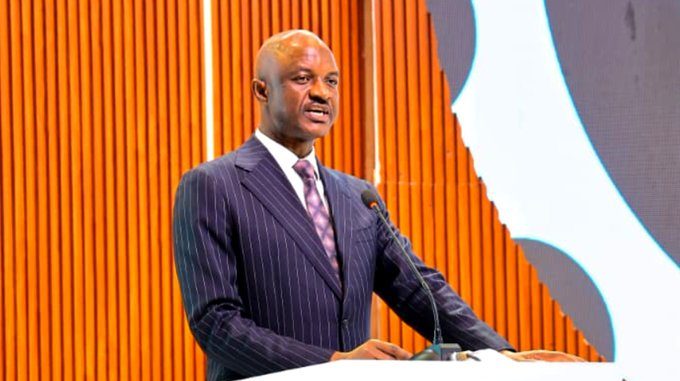
KAMPALA – Uganda’s economy has expanded to more than US$70 billion, up from approximately US$50 billion in 2023, with the Government now targeting to cross the US$100 billion mark before 2030, Permanent Secretary and Secretary to the Treasury (PSST) Dr Ramathan Ggoobi has said.
Ggoobi said the country had made progress towards its Tenfold Growth Strategy, which seeks to expand the economy to US$500 billion by 2040.
Speaking on Wednesday, November 18, 2026, at the Uganda Industrialisation Conference at Speke Resort Convention Centre in Munyonyo, Kampala, Ggoobi said the growth in the economy had changed the scale of the country’s remaining ambition.
“I have good news for you. Uganda’s economy has already expanded to more than US$70 billion. We have therefore moved from an ambition to expand the economy tenfold to one requiring approximately a further sevenfold expansion. Our next important milestone is to cross US$100 billion before 2030,” he said.
The conference was held to mark 10 years since the re-establishment of the Uganda Development Corporation (UDC) under the UDC Act of 2016.
Ggoobi said the anniversary should provide an opportunity to examine how Uganda can achieve within 15 years the industrial transformation that took other countries several generations.
He said reaching the US$500 billion target would require sustained double-digit growth in nominal US-dollar GDP, supported by higher productivity, investment, exports and macroeconomic stability.
“My central argument today is: Uganda’s next industrial revolution will not be won merely by Government spending more, but by Government investing better, coordinating better, mobilising private capital more effectively, and demanding measurable results,” Ggoobi said.
He said the country’s next phase of industrialisation would depend on how effectively Government coordinates investment, attracts private capital and ensures that public spending produces measurable economic returns.
The Tenfold Growth Strategy, launched in 2025, seeks to increase Uganda’s GDP from approximately US$50 billion in 2023 to US$500 billion by 2040.
The International Monetary Fund’s October 2026 World Economic Outlook estimates Uganda’s nominal GDP at US$72.24 billion, providing an independent estimate above the US$70 billion milestone announced by Ggoobi.
Industrialisation remains a major challenge
Despite the economic expansion, Ggoobi said Uganda still faces significant challenges in transforming its productive sectors, particularly manufacturing.
He told the conference that manufacturing value added accounts for approximately 13 percent of GDP, below the national target of 16 percent.
Capacity utilisation in manufacturing stands at about 52 percent, meaning that a substantial proportion of installed industrial capacity remains unused.
He added that industry accounts for only 12.4 percent of total employment, while manufactured goods contribute less than a quarter of merchandise exports, against the Tenfold Growth Strategy target of 50 percent.
“These figures remind us of an important distinction: our challenge is to increase manufacturing productivity, deepen domestic value addition, diversify exports and create higher-quality employment,” he said.
Ggoobi identified four lessons from countries such as South Korea, Taiwan and Singapore that Uganda should adopt: industrialisation requires coordination rather than isolated investments; industrial policy must reward performance rather than protect inefficiency; the state should create markets rather than permanently replace them; and export competitiveness must become the ultimate measure of success.
Five shifts in industrial policy
To accelerate transformation, the PSST proposed five strategic shifts in the country’s industrial policy.
These include moving from broad industrial ambitions to competitive value chains, integrating foreign investments into domestic production networks, mobilising private capital instead of relying heavily on Treasury financing, prioritising industrial competitiveness over tax incentives, and strengthening commercial discipline in state-owned investments.
He said Government should concentrate on industries where Uganda has the potential to compete, particularly agro-processing, mineral beneficiation, petroleum-related activities and other commercially viable manufacturing opportunities.
“Our domestic market alone cannot sustain tenfold economic expansion. The East African Community, COMESA and the African Continental Free Trade Area provide opportunities to produce for a much larger market,” he said.
Ggoobi also revealed that the capitalisation of Uganda Development Bank (UDB) had reached Shs2.6 trillion, while Uganda Development Corporation’s investments exceeded Shs1.5 trillion.
He said the institutions should use public capital to attract additional private investment rather than depend indefinitely on Government financing.
“The success of a development corporation should not be measured by how much public money it spends, but by how much productive investment it unlocks,” he said.
He proposed that Government, UDC and the private sector develop an Industrial Transformation Implementation Compact for 2026–2030, with clear responsibilities, annual targets and regular performance reviews.
Government calls for industries that improve livelihoods
Permanent Secretary in the Ministry of Trade, Industry and Cooperatives Lynette B. Bagonza said industrialisation must translate into tangible improvements in people’s lives through job creation, value addition, enterprise growth and expanded economic opportunities.
She emphasised the need to strengthen local industries, attract strategic investments, embrace technology and develop competitive value chains connecting Ugandan producers to regional and international markets.
The conference also marked a decade since the re-establishment of UDC in 2016, following its revival under the Uganda Development Corporation Act.
Ggoobi said the corporation’s next decade should focus on scaling commercially viable enterprises, increasing exports, mobilising private investment and strengthening domestic productive capabilities.
He urged Government agencies to move beyond announcing projects and instead measure industrial progress through actual production, exports, jobs and value addition.
“Let the next ten years be remembered not as the period in which Uganda wrote its most ambitious industrial policies, but as the period in which Uganda finally implemented them at scale,” he said.