



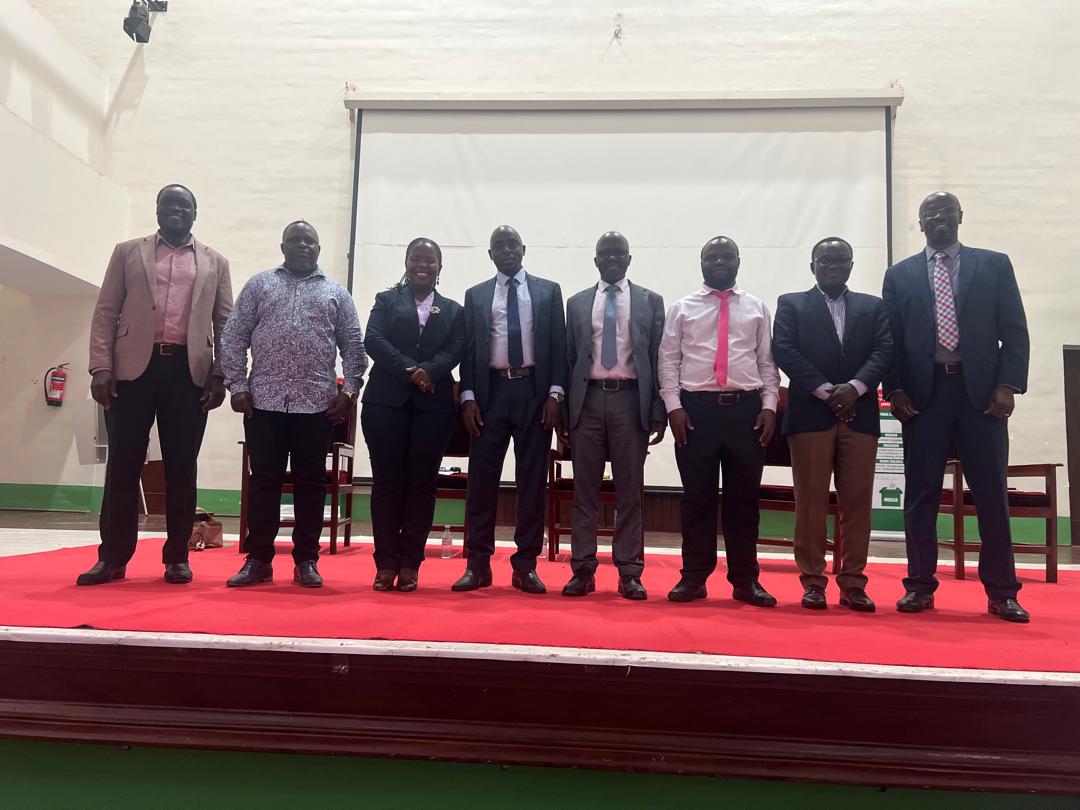
KAMPALA — Candidates seeking to represent Makerere University academic staff on the University Council have pledged to push for better staff welfare, fair promotion procedures, improved employment terms and greater accountability in the university administration.
The candidates made the pledges during a public presentation organised by the Makerere University Academic Staff Association (MUASA) at the university’s Main Hall on Friday, November 13, ahead of elections scheduled for November 24.
MUASA elects two representatives to the University Council, one male and one female. Dr Dianah Ahumuza Ateenyi, a lecturer at the School of Law, is unopposed for the female position, while four male candidates are competing for the other seat.
The candidates identified delayed promotions, employment insecurity, biometric attendance monitoring and inadequate research support among the issues requiring attention from university management.
Dr Chrispus Mayora, a lecturer at the Makerere University School of Public Health, questioned the continued use of biometric systems to assess staff performance, arguing that the university should focus on employees’ actual output.
“Biometrics is not the way to go. I proposed an output-based system,” Mayora said. “If you are teaching, supervising students or conducting research, your performance should be evaluated based on those responsibilities, not on how many times you put your face in a machine.”
Mayora, who said he had spent about 18 years at Makerere, also raised concerns about overlapping legal mandates affecting the Staff Tribunal and called for a review of the framework governing staff disputes.
On employment terms, he argued that assistant lecturers should have greater certainty in their careers, proposing probation followed by permanent employment rather than prolonged contractual arrangements.
Dr Ahumuza, who is seeking another term as the female representative, highlighted progress in staff promotions but said women remained underrepresented.
She said 434 staff members had been promoted between February 2023 and November 2026, while about 70 other cases delayed by structural challenges were expected to be considered at a University Council meeting scheduled for November 17.
However, she said women accounted for only about 30 per cent of the promotions. “Why should women account for only 30 per cent of academic promotions? Should we not already be moving towards a 50-50 balance?” she asked.
Ahumuza said the Council had approved changes to the promotion process requiring applications to receive a decision within a maximum of three months.
She also called for clearer career progression for technical staff, including library technicians, and a review of academic promotion criteria to ensure that scholars in humanities and other disciplines were assessed fairly.
Dr Robert Kakuru Tibamwenda, a lecturer in the College of Humanities and Social Sciences and former MUASA chairperson, focused on remuneration, staff welfare and career progression.
He said that when he joined Makerere in 2013, some employees had waited as long as 15 years for promotion. He later served as MUASA General Secretary from February 2018 and participated in efforts to improve remuneration for public university staff.
Tibamwenda said he had been involved in efforts to secure and defend approximately Shs66 billion for salary enhancement. “My position has always been that salary enhancement should benefit all staff, rather than a selected category,” he said.
He also called for fair promotions, improved staff healthcare, research funding, better infrastructure and clearer career pathways for technical employees.
Dr Deus Kamunyu Muhwezi, a lecturer in the Department of Forestry, Biodiversity and Tourism, said his experience in staff leadership had exposed him to challenges involving administrative procedures, financial accountability and the treatment of university employees.
He referred to an earlier dispute in which he said he had been suspended for seven months, arguing that staff should be able to raise concerns about the institution without being treated as adversaries. “My experience in these matters has shaped how I understand leadership and representation,” Muhwezi said.
Dr Ibrahim Karume, a lecturer in the Department of Chemistry, also called for greater attention to staff welfare and career progression.
Karume, who said he joined Makerere in 2001, argued that unresolved workplace challenges could affect employees’ mental well-being. “Most of the time, we are dealing with the symptoms. All these things eventually lead to mental stress,” he said.
MUASA Electoral Commission chairperson, Dr Milton Wabyona, urged the candidates and their supporters to maintain civility during the campaigns.
Wabyona said the commission was committed to organising a transparent, fair and credible election, adding that the voters’ register would be drawn from the university’s Human Resource records and organised according to college constituencies.
He said voting would take place physically on November 24. “The responsibility of a representative is to carry the views and interests of the electorate, rather than impose personal opinions and interests on those they represent,” Wabyona said.
Assoc. Prof. Jude Sempebwa, chairperson of Makerere University Management and University Council, said the election was central to the association’s constitutional commitment to democracy.
Citing Article 2(h) of the MUASA Constitution, which recognises democracy as an inalienable right of members, Sempebwa said the representatives would have an important role because decisions affecting academic staff are made at the University Council.
“MUASA is the soul of this university. But the decisions that affect MUASA members are made at the University Council. That is why we take representation on that council very seriously,” he said.
He urged candidates to focus on practical ideas for improving the university rather than treating the election merely as a contest for positions.
The November 24 election will determine the two academic staff representatives who will serve on Makerere University Council for the 2026–2030 term.