



Uganda plans to expand its rehabilitated metre-gauge railway network from 215 kilometres to 667 kilometres, construct a 234-kilometre Standard Gauge Railway (SGR) line between Malaba and Kampala and develop additional routes to support cargo transportation, industrialisation and regional trade.
The expansion is part of the Government’s long-term plan to make railway transport the backbone of the country’s logistics system and reduce the cost of moving goods, as Uganda pursues its ambition of growing the economy tenfold, from about $50 billion to $500 billion by 2040.
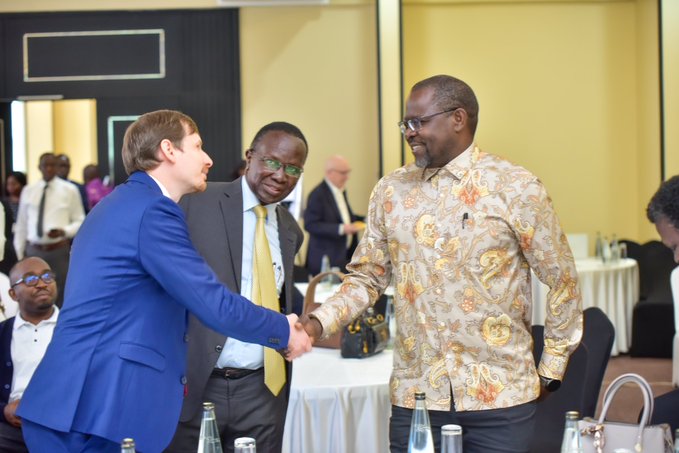
Minister of State for Transport Julius Maganda Wandera outlined the plans during the first-ever Uganda Railways Corporation (URC) Stakeholder Engagement Forum held at Mestil Hotel in Kampala.
Maganda said the Government was shifting its approach to railway transport, treating it not merely as an old infrastructure asset but as a strategic instrument for economic transformation.
Under the National Integrated Transport Master Plan 2021–2040, the railway expansion will include reconstruction of the Gulu-Pakwach line and development of the Soroti-Moroto railway into the mineral-rich Karamoja sub-region, with a planned extension towards South Sudan.
The government also plans to introduce commuter railway services across Greater Kampala, connecting Mukono, Nalukolongo, Kyengera and Port Bell.
The minister said the investments were necessary to move heavy cargo away from roads, which are increasingly being damaged by trucks transporting goods over long distances.
He argued that railway transport could significantly reduce the cost of doing business, noting that moving a container from Mombasa to Kampala by rail should cost about half the price of transporting it by road.
“Rail must carry Uganda’s heavy cargo to drive the tenfold growth,” Maganda said.
To support the expansion, the Government is preparing a new Uganda Railways Bill, which will soon be presented to Parliament, with railway safety among its central considerations.
The proposed infrastructure is expected to serve several priority sectors, including agriculture, mining, oil and gas, manufacturing and exports.
Maganda said agro-industrialisation would depend on affordable bulk transportation of agricultural produce through logistics terminals such as Gulu, Mbarara and Tororo.
The minerals and oil and gas industries are also expected to benefit from railway connections serving Kasese, Pakwach and Karamoja.
The government further wants to increase exports from the current 12 per cent to 50 per cent of gross domestic product, a target the minister said would require competitive transportation costs to international markets.
Standard Gauge Railway progresses
On the Malaba-Kampala Standard Gauge Railway, Maganda said preliminary works were progressing under a Limited Notice to Proceed issued to contractor Yapı Merkezi.
Preparatory activities, including the establishment of a sleeper manufacturing factory and a construction camp in Iganga, were in their final stages.
He added that about 70 per cent of the land required for the project had been acquired.
The 234-kilometre railway is expected to strengthen Uganda’s connection to the Port of Mombasa and improve the movement of imports and exports along the Northern Corridor.
Existing railway network expansion
URC Managing Director Benon Kajuna said the corporation was emerging from a difficult period of institutional transformation and preparing for a phase of sustainable growth.
He said the railway network operated by the corporation was expected to expand from 269 kilometres to approximately 650 kilometres by the end of 2026, following completion of the Tororo-Gulu railway line.
Kajuna also said URC was exploring ways of integrating railway operations with marine transport and other logistics services, including inland water transport.
The approach is intended to create a more connected transport system in which cargo can move between railway lines, inland ports and other distribution points.
URC Board Chairperson Daudi Migereko said the corporation would focus on translating its strategic plan into measurable performance, while encouraging private sector participation in railway infrastructure and services.
He identified freight logistics, marine transport, railway terminals, railway property and passenger services as areas offering investment opportunities.
Migereko said these opportunities were too significant to depend on public investment alone and called on private companies to partner with URC.
Development partners support railway plans
The European Union Delegation in Uganda, represented by Jakob Haushofer, said Team Europe, comprising the EU, Spain, France and European financial institutions, had supported Uganda’s railway development since 2018.
The support has included technical assistance, development of the Gulu Logistics Hub, rehabilitation of the Kampala-Malaba railway line and preparation of the Greater Kampala commuter rail project.
The commuter rail project is expected to serve up to 400,000 passengers daily.
Haushofer said European companies and financial institutions were also exploring opportunities to participate in the Standard Gauge Railway project.
He emphasised the need to ensure that infrastructure projects were investment-ready and institutions had the capacity to implement them.
He also pointed to the importance of reliable electricity supply, particularly as Uganda considers the requirements of modern and potentially electrified railway infrastructure.
URC said the stakeholder engagement forum would become an annual event, bringing together Government, development partners, customers, private investors and the media to assess progress and identify areas requiring collaboration.
The planned expansion comes as Uganda seeks to reduce its dependence on road transportation, lower logistics costs and improve the competitiveness of locally produced goods in regional and international markets.