




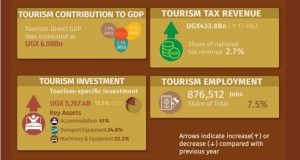
Uganda’s tourism sector contributed Shs6.99 trillion to the country’s Gross Domestic Product (GDP) in 2024, accounting for 3.3 per cent of the economy, while directly supporting more than 876,000 jobs, according to a new government report.
The Uganda Tourism Satellite Account Report for 2024, compiled by the Ministry of Tourism, Wildlife and Antiquities in collaboration with the Uganda Bureau of Statistics (UBOS), shows that tourism’s direct contribution to GDP increased by 15.2 per cent from Shs6.06 trillion in 2023.
Tourism’s direct Gross Value Added (GVA), which measures the value created by tourism-related industries after deducting intermediate inputs, increased by 15.1 per cent from Shs5.69 trillion in 2023 to Shs6.55 trillion in 2024. This represented 3.1 per cent of Uganda’s national Gross Value Added, according to the report.
Tourism-related employment also grew by 9.1 per cent, from 803,691 workers to 876,512, representing 7.5 per cent of Uganda’s total employment.
In the report’s foreword, Doreen S. Katusiime, the Permanent Secretary in the Ministry of Tourism, said the findings reaffirm tourism’s position as a strategic sector because of its contribution to employment, foreign exchange earnings and household welfare.

“These results reaffirm tourism’s critical role in advancing Uganda’s national development agenda, particularly under the National Development Plan IV and the Government’s broader strategy for inclusive growth, job creation, and export diversification,” Katusiime said.
She urged policymakers, development partners and private sector players to use the findings to “strengthen coordination, promote investment, and unlock the full potential of tourism as a driver of Uganda’s socio-economic transformation.”
The report attributes the sector’s growth to increased activity in passenger transportation, accommodation, food and beverage services, cultural activities and recreation.
Passenger transportation accounted for the largest share of tourism’s direct GDP contribution at 33.7 per cent, followed by accommodation services at 25.9 per cent and food services at 16 per cent.
Tourism industry output increased by 21.2 per cent, from Shs12.02 trillion in 2023 to Shs14.58 trillion in 2024. Food and beverage services generated Shs4.87 trillion, passenger transport Shs4.61 trillion and accommodation Shs3.72 trillion.
Foreign visitors spend Shs4.8 trillion
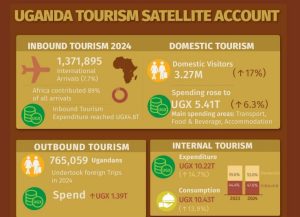
Uganda received approximately 1.37 million international visitor arrivals in 2024, a 7.7 per cent increase from the previous year.

Spending by foreign visitors rose by 25.9 per cent, from Shs3.81 trillion to Shs4.81 trillion. The expenditure accounted for 11.9 per cent of Uganda’s total exports and 50.6 per cent of service exports.
The country recorded a tourism trade surplus of Shs3.41 trillion, up from Shs2.76 trillion in 2023, meaning foreign visitors spent considerably more in Uganda than Ugandans spent on travel abroad.
Outbound tourism expenditure nevertheless increased by 31.4 per cent to Shs1.39 trillion, while the number of Ugandans travelling abroad rose by 7.6 per cent to 765,059.
Kenya was the leading destination, accounting for 38.7 per cent of outbound trips. East African countries collectively received 76.7 per cent of Ugandans’ foreign journeys.
Domestic tourism generates Shs5.4 trillion
Domestic tourism also expanded, with an estimated 3.27 million Ugandans participating in tourism activities within the country, up 17 per cent from 2.79 million in 2023.

Ugandans made approximately 20 million domestic trips during the year, compared with 17.1 million in 2023. Overnight visitors accounted for 10.4 million trips, while same-day visitors made 9.6 million.
Visiting friends and relatives was the leading reason for domestic travel, accounting for 55.3 per cent of trips. Leisure and holidays represented 13.8 per cent, while business travel accounted for 9.4 per cent.
Domestic tourism expenditure increased by 6.3 per cent to Shs5.41 trillion. Passenger transport accounted for Shs3.03 trillion, or 56.4 per cent, followed by food and beverage services at Shs1.07 trillion and accommodation at Shs846.9 billion.
The average length of stay increased from 6.3 nights to 7.4 nights. Overnight visitors spent an average of Shs95,965 daily, compared with Shs48,589 for same-day visitors.
Beyond spending by domestic and international visitors separately, internal tourism expenditure — which combines inbound and domestic visitor spending — increased by 14.7 per cent to Shs10.22 trillion in 2024, from Shs8.91 trillion in 2023.
When other components of tourism consumption are included, total internal tourism consumption reached Shs10.43 trillion, up from Shs9.16 trillion. The report says internal tourism expenditure represented 5.9 per cent of Uganda’s combined Household Final Consumption Expenditure and exports, compared with 5.8 per cent in 2023. Domestic tourism expenditure alone accounted for four per cent of household final consumption expenditure.
Jobs, taxes and investment
Passenger transportation was the largest employer in the tourism sector, with 561,012 workers, representing 64 per cent of direct tourism employment. Food and beverage services employed 241,912 people, while accommodation services accounted for 24,761 jobs.
The report shows that self-employment accounts for 61 per cent of tourism jobs, compared with 39 per cent held by employees. Men represented 75 per cent of the workforce, while women accounted for 25 per cent.
Tourism-generated taxes increased by 17.4 per cent, from Shs369.5 billion in 2023 to Shs433.8 billion in 2024. The sector contributed 2.7 per cent of total national tax revenue.
Government expenditure on tourism-related collective services, including tourism promotion, administration, research and educational support, increased by 72.9 per cent to Shs616.9 billion in 2024. This represented 0.86 per cent of total Government Final Consumption Expenditure, compared with 0.7 per cent in 2023.
However, tourism-specific capital investment declined by 22.7 per cent, from Shs7.46 trillion in 2023 to Shs5.77 trillion in 2024. Its share of national gross fixed capital formation fell from 17.2 per cent to 12.6 per cent.

Accommodation facilities attracted the largest share of tourism investment at Shs2.37 trillion, followed by passenger transport equipment at Shs1.43 trillion and specialised machinery and equipment at Shs1.29 trillion.
UBOS Executive Director and Chief Statistician Dr Chris N. Mukiza said the Tourism Satellite Account enables Uganda to measure the sector’s contribution using internationally recognised statistical standards.
“The TSA quantifies tourism’s direct contribution to key macro-economic aggregates, including gross domestic product, employment, and value added, while also illustrating the linkages between tourism demand and the supply of goods and services across the economy,” Mukiza said.
He said the framework provides a basis for assessing tourism’s contribution to socio-economic development and guiding policy and investment decisions.
The report draws on data from UBOS, the Bank of Uganda, the Ministry of Internal Affairs, the Uganda Revenue Authority and Uganda Tourism Board, among other institutions. It follows the United Nations-backed Tourism Satellite Account Recommended Methodological Framework of 2008.