


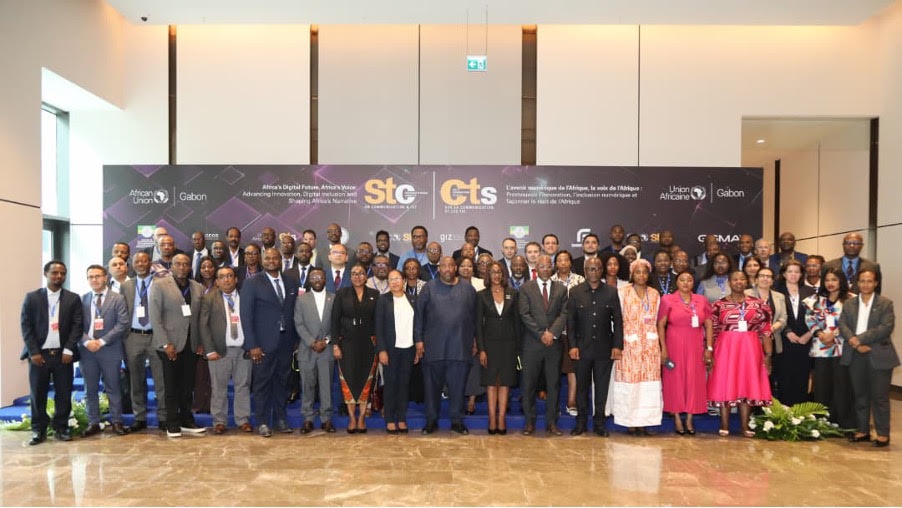
The African Union has opened a continental meeting on communication and information technology in Libreville, Gabon, to advance digital transformation policies, including artificial intelligence, connectivity and secure data exchange, ahead of the bloc’s January 2027 summit.
The sixth Ordinary Session of the Specialised Technical Committee on Communication and Information and Communications Technology (STC-CICT) brings together government officials, technical experts and development partners to develop recommendations on Africa’s digital agenda.
The discussions are relevant to Uganda as an African Union member state, particularly in shaping continental cooperation on digital infrastructure, public services, data protection and access to emerging technologies.
Dr Kamugisha Kazaura, Director of Infrastructure and Energy at the African Union Commission, said emerging technologies, particularly artificial intelligence, were becoming increasingly important to the continent’s digital transformation.
“Connectivity, secure data exchange and interoperability are foundations for integrated public services and digital innovation. By advancing them together, Africa can create more opportunities for its people and take a stronger role in shaping the global digital future,” Kazaura said.
He called on delegates to develop practical technical recommendations to inform ministerial decisions and support implementation of the continent’s digital priorities.
Aline Sylvie Minko-Mi-Etoua, Secretary General of Gabon’s Ministry of Digital Economy, Digitalisation and Innovation, said decisions made by the committee would have direct consequences for citizens and businesses.
“Behind every text you examine are concrete issues: access to knowledge, economic opportunities and the protection of citizens’ data,” she said.
Minko-Mi-Etoua urged delegates to ensure that their recommendations were practical and responsive to the circumstances of all AU member states, regardless of their levels of development and available resources.
Representing the United Nations Economic Commission for Africa, Robert Lisinge said digital transformation should be assessed by its contribution to development rather than connectivity alone.
“Its success must be measured by the opportunities we create, the services we improve and the people we reach,” Lisinge said.
He called for reliable digital infrastructure, affordable access, relevant services and practical digital skills to accompany efforts to expand connectivity.
Kanono Ramashamole, Principal Secretary of Lesotho’s Ministry of Information, Communications, Science, Technology and Innovation and outgoing chair of the committee, urged member states to maintain unity and consensus as they worked towards shared continental priorities.
“Consensus among 55 Member States is neither easy nor automatic. It requires patience, mutual respect and a willingness to recognise that our collective African interests are greater than our individual differences,” Ramashamole said.
He urged delegates to identify practical actions that could accelerate implementation and strengthen cooperation among member states.
In a separate note, Margaret A. Kafeero, the Minister-Counsellor at the Permanent Mission of Uganda to the African Union, said the meeting was important in the run-up to the 34th AU Summit scheduled for January 2027, whose theme is “AU at the Dawn of its 25th Anniversary: Leveraging the Full Potential of SAATM and New Technologies for Continental Integration.”
New bureau elected
Following the opening session, delegates elected a new bureau to guide the committee’s work during the sixth ordinary session.
Ghana was elected chair, representing West Africa, while Kenya took the first vice-chair position for East Africa. Gabon was elected third vice-chair for Central Africa, and Lesotho became rapporteur for Southern Africa.
The second vice-chair position, representing North Africa, was yet to be confirmed in the information provided by the African Union Commission.
The bureau’s composition follows the principle of equitable geographical representation across Africa’s five regions. It will guide deliberations and help coordinate recommendations for consideration by the relevant AU policy organs.
The committee’s work is taking place as African governments seek to coordinate their approaches to rapidly evolving technologies and strengthen the infrastructure needed to support cross-border services, digital trade and public administration.
For Uganda, the discussions provide a continental policy context for issues such as affordable internet access, secure data exchange, digital skills and the use of emerging technologies in public services.
AU invites young africans to design 2027 summit logo
As part of preparations for the 2027 summit, the African Union Commission is also inviting young African creatives to compete to design the official logo and visual identity for the AU Theme of the Year 2027.
The submission deadline is October 31, 2026, according to the AU’s official competition entry page. The competition is open to citizens of AU member states aged 18 to 24 by the deadline, including young designers, artists, students and digital creatives. Entries must be individual and original. Generative artificial intelligence is not permitted. African Union competition details and official entry form.
The winning design will provide the visual identity for the 2027 theme, which connects the African Union’s 25th anniversary with the Single African Air Transport Market (SAATM), new technologies and continental integration.
The competition offers cash prizes of $5,000 for first place, $2,000 for second place and $1,000 for third place. The winner will also have an opportunity to attend the AU Summit, where the selected logo is expected to be unveiled.
The logo competition provides a practical opportunity for young creatives to contribute to the visual identity of a continental agenda that places connectivity, technology and African integration at its centre.
The STC-CICT session also feeds into preparations for the 34th AU Summit in January 2027, which will focus on continental integration through SAATM and new technologies.