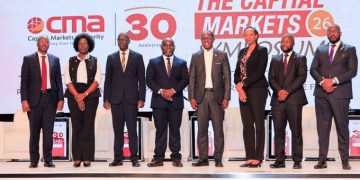



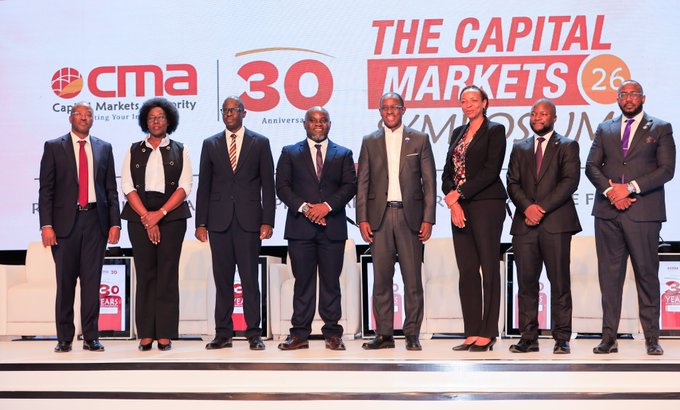
National Social Security Fund (NSSF) Managing Director Patrick Ayota has urged Uganda’s capital market players to participate in shaping the rules and direction of the market, saying greater involvement could make investment opportunities more accessible to businesses beyond the traditional elite.
Ayota made the call while delivering the keynote address at a symposium marking 30 years of the Capital Markets Authority (CMA), held under the theme, “Re-imagining Uganda’s Capital Markets for a Sustainable Future.”
“Can we bring players together so that we can begin to create rules and directions that they contribute towards? In that case, the way you package capital becomes very friendly to them, rather than just for the elite,” Ayota said.
He cited the experiences of major international stock exchanges, including those in London and New York, and the NASDAQ market, arguing that market participants had played a role in establishing the rules governing their operations.
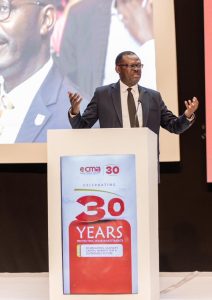
Ayota challenged Uganda’s capital markets to draw lessons from that experience as they enter their next phase of development, particularly by involving young entrepreneurs and innovators in shaping the market.
He said Uganda already had a primary market and options for small businesses, but expanding participation would require bringing more players into discussions about how capital is structured and made available.
The symposium was organised as CMA marked three decades of regulating and developing Uganda’s capital markets.
Government identifies priorities for capital market growth
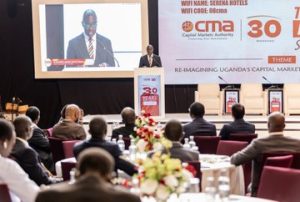
Joseph Enyimu, Commissioner for Economic Development Policy and Research at the Ministry of Finance, Planning and Economic Development, said capital markets remained central to the Government’s ambition of expanding Uganda’s economy to $500 billion.
Representing the Minister of Finance at the event, Enyimu said the Government intended to strengthen the role of capital markets in mobilising long-term financing for economic development.
“As we work to meet the goal of expanding our economy to USD 500 billion, capital markets remain a priority for Government,” Enyimu said.
He outlined five areas through which the Government intends to support the sector.
These include encouraging public enterprises to raise long-term financing through capital markets to reduce pressure on the Consolidated Fund, using capital markets to finance infrastructure projects and deepening the government securities market.
The Government also plans to review tax and regulatory measures to encourage long-term investment through capital markets.
Enyimu said authorities would work with pension sector stakeholders to enable pension funds to invest a larger share of their assets in long-dated Ugandan securities, subject to prudent investment limits.
The measures are intended to expand the sources of financing available to businesses and public institutions while strengthening the domestic investment market.
CMA reflects on 30 years of market development
CMA Chief Executive Officer Josephine Okui Ossiya said the authority’s journey began with a small team working to establish a market capable of connecting investors with businesses seeking capital.
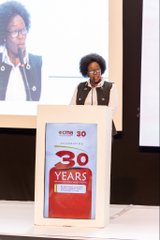
“Thirty years ago, a small team began building that possibility,” Ossiya said.
Speaking at the anniversary celebrations, she paid tribute to the individuals who established the institution, as well as successive boards, staff members, market participants and development partners who have contributed to its growth.
Ossiya also posed a question about the purpose of capital markets and their role in national development. “Can we build a market that brings our savings and ambitions together?” she asked.
She said the authority’s work over the past three decades had focused on connecting businesses and investors, adding that capital markets would remain important to Uganda’s ambition of building a $500 billion economy.
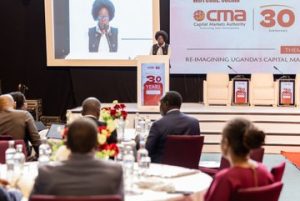
Ossiya thanked the CMA board, employees and partners for their contribution to the institution’s development.
She said the anniversary offered an opportunity to recognise the progress made while looking ahead to a stronger and more vibrant capital market.
Sseremba recalls CMA’s beginnings
CMA Board Chairperson Saul Sseremba traced the authority’s history to its early days in the basement of the Bank of Uganda.
He recalled that the institution operated from what he described as the “zero floor” before Uganda’s capital market developed into a system increasingly supported by electronic trading and record-keeping.
“In those days, trading meant brokers calling out bids and offers and writing them on a whiteboard with marker pens, a method known as the ‘open outcry’,” Sseremba said.
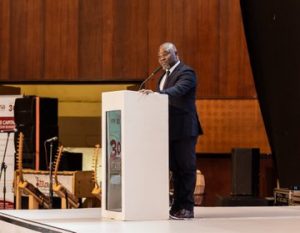
He contrasted the early trading arrangements with the current system, in which shares are held electronically, and transactions are matched through automated systems.
The transformation reflects changes in the organisation and operation of Uganda’s capital markets over the authority’s 30-year history.
The anniversary symposium brought together government representatives, financial sector leaders and other stakeholders to discuss how the market can mobilise investment and support the country’s long-term economic ambitions.