




KAMPALA — Finance Minister Henry Musasizi has urged Members of Parliament to support measures to broaden Uganda’s tax base as Government seeks to increase domestic revenue, reduce reliance on borrowing and strengthen fiscal self-reliance.
Musasizi said Uganda cannot achieve its target of raising the tax-to-GDP ratio from the current 14.7% to 20% by the 2029/30 financial year by continually increasing the burden on taxpayers already in the system.
“The answer cannot simply be higher tax rates. We cannot achieve 20% by continuously taxing the same people more,” Musasizi said.
He was speaking during an engagement between the Uganda Revenue Authority (URA) and parliamentary committees at Serena Hotel in Kampala.
Musasizi said the focus should instead be on bringing more economic activity into the formal tax system, improving compliance and administration, and reducing revenue leakages.
“Before asking compliant taxpayers to pay more, we must first ask: Is everyone who should be paying actually paying? Are taxpayers declaring the correct amounts? Are all economic sectors making an appropriate contribution?” he said.
He said Government had tasked URA with strengthening intelligence, sector analysis, third-party information, risk profiling and the use of Government data to identify tax gaps.
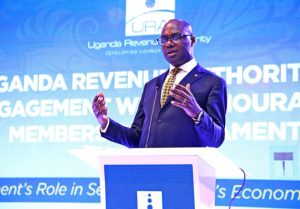
“Our objective should be simple: make it easier to comply and progressively more difficult to evade,” Musasizi said.
The Minister linked domestic revenue mobilisation to Government’s Tenfold Growth Strategy, which targets a US$500 billion economy over the next 15 years.
He said achieving the target would require investment in infrastructure, energy, education, healthcare, industrial development and other public services, adding that Uganda could not depend indefinitely on borrowed resources to finance its development.
“We cannot build a USD 500 billion economy on borrowed resources. Neither can we expect development partners to finance our transformation indefinitely,” he said.
Musasizi said the revenue drive should therefore be supported by economic growth, formalisation, digitalisation, improved tax administration, taxation of emerging economic activities and stronger information sharing among Government institutions.
URA Commissioner General John Rujoki Musinguzi said the authority’s task was becoming more complex as Uganda’s tax base changes.
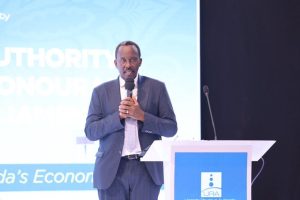
He identified structural informality, the rapid growth of the digital economy, cross-border businesses, offshore incomes, fragmented Government data, regional tariff harmonisation and illicit trade among the challenges affecting revenue mobilisation.
Musinguzi said URA would focus on mapping and registering priority sectors, taxpayer education and compliance, and risk-based enforcement.
URA has also been implementing a data-driven compliance strategy for the 2026/27 financial year, using taxpayer information, transactions, sector trends and other lawful data to identify compliance gaps.
He called for stronger information sharing across Government institutions to help identify economic activity that is currently outside the tax net.
Finance Committee Chairperson Maximus Ochai, MP for West Budama County North, said Parliament needed more time to scrutinise proposed tax measures before the next financial year.

Ochai said the timetable for developing tax policies should be reviewed to give MPs adequate time to examine the measures and their implications.
“With those proposals, we would wish to have the standard reports that inform the greatest tax measures,” Ochai said.
The engagement comes as URA continues to pursue reforms aimed at expanding the taxpayer register and improving compliance. The authority has also begun implementing the transition to the National Identification Number (NIN) as the primary tax identifier for individual taxpayers, following a Cabinet decision on September 1, 2026.