



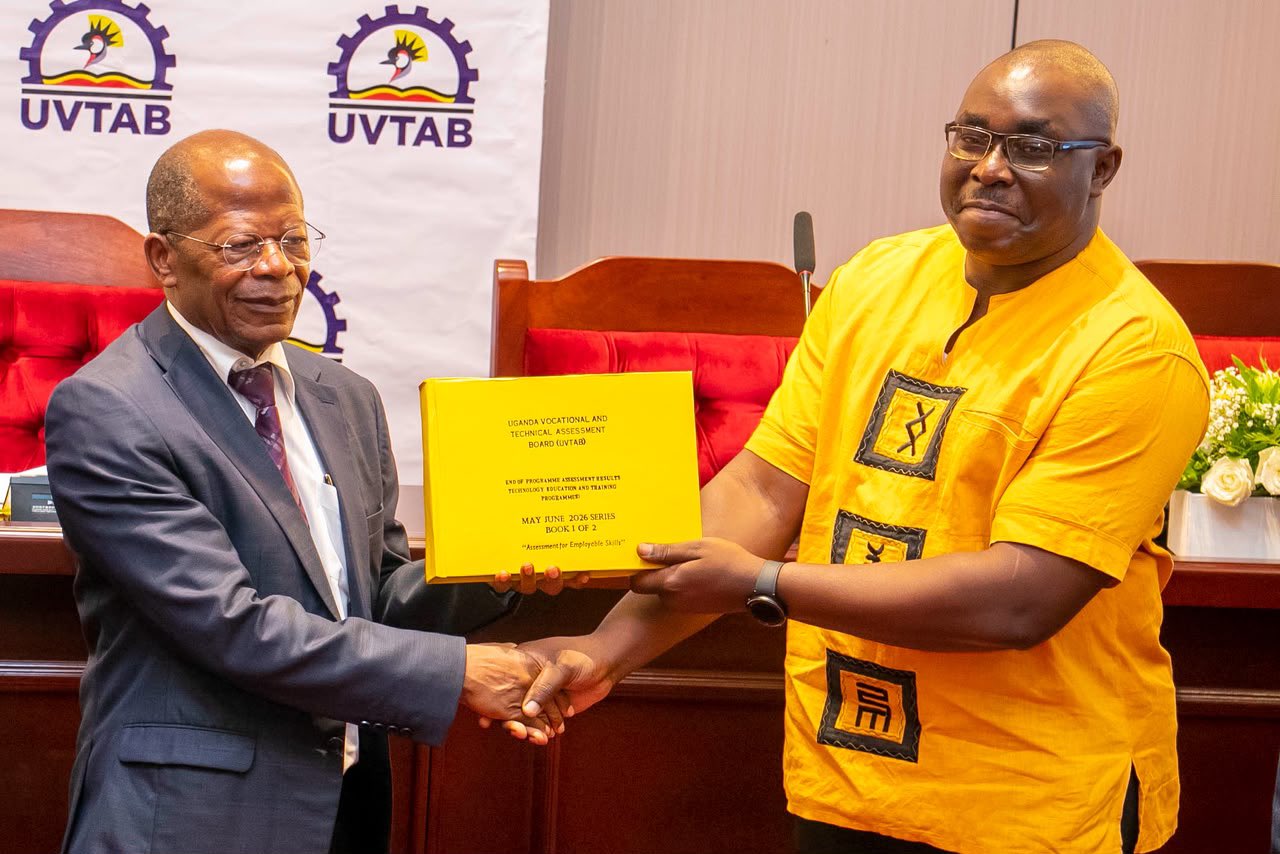
The Government has reaffirmed its commitment to expanding technical and vocational education and training (TVET), positioning skills development at the centre of efforts to address unemployment, close labour-market gaps and support Uganda’s economic transformation.
Speaking on Wednesday during the release of the May/June 2026 Uganda Vocational and Technical Assessment Board (UVTAB) results, Acting Minister of Education and Sports, John C. Muyingo, said Uganda’s ambition is to have citizens acquire specialised skills that can translate into productive enterprises, job creation and increased national productivity.
Muyingo said TVET would be critical to Uganda’s development priorities under the National Development Plan IV, particularly in agro-industrialisation, manufacturing, tourism and services, sectors that require a skilled and adaptable workforce.
“With the new TVET agenda, the interest of Government is to have all Ugandans certified in one or more specialised skills,” Muyingo said, emphasising the role of technical training in preparing Ugandans for the demands of the economy.
He said Government would continue funding trainee sponsorship programmes, with plans to expand access to TVET by providing opportunities for trainees to pursue lower-level programmes free of charge, particularly to increase access among young people.
The Minister also called for stronger collaboration between TVET institutions and industry, saying employers and other players in the world of work have an important role in shaping a responsive and high-quality skills system.
His remarks come as UVTAB continues to align training and assessment with labour-market requirements.
The Board Chairperson, Assoc. Prof. Dorothy Okello, said UVTAB had reviewed 31 curricula and 22 Assessment Training Packages to ensure that graduates acquire practical competencies relevant to industry.
Of the 31 curricula reviewed, 18 were in Technology, 12 in Business and one in Home Science Education. Okello said 17 of the reviewed programmes had already been approved by the TVET Council for Level 4 trainees in Uganda Technical Colleges.
She said the Board was also benchmarking its assessment standards against institutions and skills systems elsewhere in Africa while engaging with the WorldSkills movement to strengthen Uganda’s ability to prepare graduates for an increasingly competitive global labour market.
Okello said the changing world of work, driven by technological advancement, digitalisation and emerging industries, requires assessment systems to evolve continuously so that graduates are not only certified but are competent, innovative and adaptable.
The Executive Secretary of UVTAB, CPA Onesmus Oyesigye said the May/June assessment results provided evidence of generally satisfactory competence among candidates, although gaps remained in selected programmes.
The Board identified weaknesses in areas including Automobile Engineering, Refrigeration and Air Conditioning, Automotive Engine Technology II, Building Services and Software Engineering at diploma level. In Business Education and Training, Entrepreneurship Skills, Elements of Taxation and Shorthand IV were identified as areas requiring additional attention.
The Executive Secretary said the findings would inform targeted remedial training, strengthened practical instruction and closer support for programmes where higher levels of partial competence were recorded.
The results also showed strong outcomes in several fields, with 84.4 per cent of the 17,038 candidates who sat the May/June assessments acquiring full competence.
National Diploma candidates recorded an 87.5 per cent full competence rate, while 76.7 per cent of National Certificate candidates achieved full competence.
The Minister commended UVTAB for developing curricula and Assessment Training Packages in collaboration with employers, Sector Skills Expert Committees, TVET providers and other stakeholders.
He said such employer-led approaches were important in reducing skills mismatches and ensuring that graduates leave training institutions with competencies that correspond to changing labour-market demands.
The Government has also strengthened the regulatory framework for the sector through new regulations governing admission of trainees and the governance, management and administration of public and private TVET providers.
Meanwhile, UVTAB is progressing with the construction of a printery warehouse and logistics hub in Namanve, which the Minister said would serve as an innovation hub supporting the country’s skilling agenda.
The Board has also operationalised guidelines for assessing candidates with special needs and refugees. During the May/June assessment series, 57 candidates with special needs were assessed, with 48 acquiring full competence.