


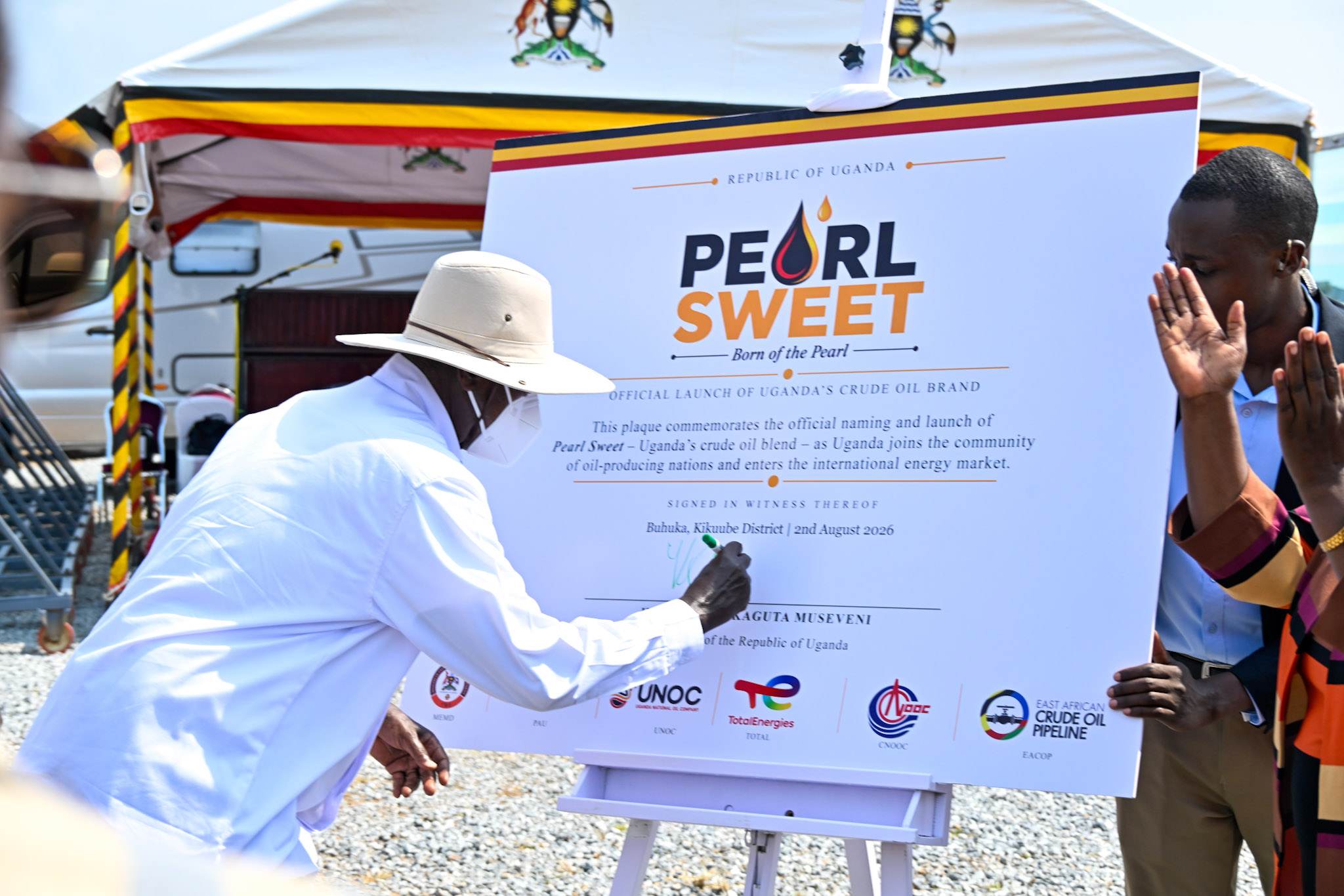
President Yoweri Kaguta Museveni has named Uganda’s crude oil “Pearl Sweet Petroleum”, ahead of the country’s anticipated first commercial oil production.
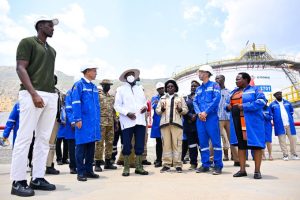
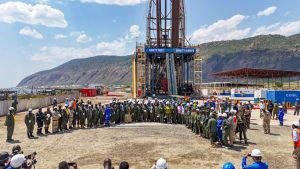
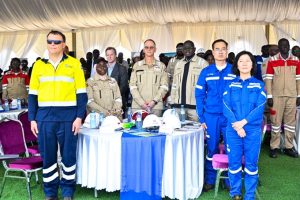
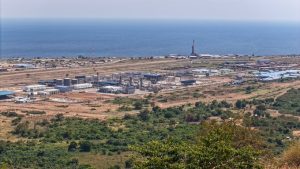
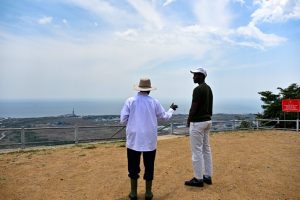
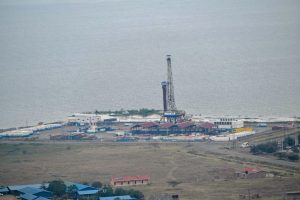
Museveni unveiled the name on Thursday during a visit to the Kingfisher Oilfield in Buhuka, Kikuube District, where the Central Processing Facility (CPF) has reached mechanical completion, marking a major milestone in Uganda’s transition from oil development to production.
Explaining the name, Museveni said “Sweet” refers to the crude’s low sulphur content, which makes it less costly to refine, while “Pearl” reflects Uganda’s identity as the Pearl of Africa.
“We are here to celebrate and give this baby (oil) a name. These people have told me to name this baby Pearl Sweet Petroleum. We call it sweet because it does not have sulphur. When it has sulphur, it is more expensive to remove the sulphur. This one either has little or no sulphur,” Museveni said.
The President said Uganda must use its petroleum resources to drive industrialisation rather than simply exporting crude oil.
“The petroleum industry would push us very far,” he said, pointing to the planned refinery and its capacity to produce fuel for vehicles, aviation fuel and other petroleum products.
“So, what is happening here is not a joke. It will have a lot of implications,” Museveni added.
He said Uganda still has significant potential for additional oil discoveries in the Lake Albert region, noting that exploration has so far covered only about 40 per cent of the lake.
“The 6.5 billion barrels of oil that were confirmed only cover 40 per cent of Lake Albert. We still have 60 per cent to explore,” he said.
Refinery remains central to Uganda’s oil strategy
Museveni reiterated that the planned oil refinery remains a priority despite the development of the East African Crude Oil Pipeline (EACOP), which will transport Uganda’s crude to Tanzania’s Tanga Port.
He argued that domestic refining would reduce the costs associated with importing petroleum products, particularly transportation and transit charges.
“Our refinery will be one of the most profitable because, first of all, it’s far from the ocean and it does not have the transportation cost which imported oil has. When we refine our oil here, you don’t pay transit charges,” he said.
Museveni said Uganda currently spends about $2 billion annually importing petroleum products and could reduce that burden by refining its own crude.
“When we pump our crude to Tanga, we pay $12.77 per barrel just for transport. When we refine our oil here, we don’t pay that money. We shall no longer spend $2 billion importing petroleum,” he said. “You can export some of the crude, but the refinery must get priority. That is what is in our agreement.”
The President also warned against using oil revenues to finance consumption and luxury imports.
Instead, he said proceeds from the finite resource should be invested in infrastructure and other assets that can benefit future generations.
“The money will be used to do durable things — to build power stations, build the railway and other things which will be there for the grandchildren,” he said.
Uganda rejects gas flaring
Museveni also said Uganda would not allow associated gas produced from the Kingfisher field to be flared.
Instead, the gas will be used to generate electricity and produce Liquefied Petroleum Gas (LPG) for cooking. “Here, we said no to flaring gas. We shall be using the gas to generate electricity, up to 80 megawatts at Kingfisher alone,” he said.
According to Museveni, the planned 80-megawatt generation capacity would be equivalent to roughly half the output of Nalubaale Power Station and could generate about $30 million annually for the project.
“The other gas will be condensed and turned into liquified petroleum gas for cooking,” he added.
The approach reflects the government’s stated intention to link petroleum production to broader industrial development and energy security.
Government highlights wider benefits
The Chinese Ambassador to Uganda, Wu Guangrong, reaffirmed China’s commitment to strengthening cooperation with Uganda in oil and gas, trade, infrastructure and investment.
He said the partnership should go beyond extracting petroleum to include technology transfer, skills development, employment, local content and industrialisation.
Prime Minister Robinah Nabbanja said the oil programme had already contributed to infrastructure development in the Bunyoro sub-region.
She cited the construction of Kabalega International Airport and Kabalega Industrial Park, more than 500 kilometres of tarmacked roads and improvements in health facilities.
Nabbanja also described Museveni’s visit to Kingfisher as an opportunity to assess the progress of a petroleum vision that began decades ago.
She recalled that after coming to power in 1986, Museveni sent young Ugandans abroad to acquire expertise in the petroleum sector.
Energy and Mineral Development Minister Dr Monica Musenero said the name “Pearl Sweet” captures both the characteristics of Uganda’s crude and the country’s national identity.

“For many years, petroleum in Uganda was an aspiration; something discovered, studied, debated and planned for. Today, that resource is being translated into productive assets, infrastructure, skills, businesses and, very soon, commercial production,” Musenero said.
“This moment is therefore a testament to the importance of your vision, persistence and strategic leadership,” she told Museveni.
Kingfisher moves closer to first oil
The Permanent Secretary in the Ministry of Energy and Mineral Development, Eng. Pauline Irene Batebe, said the Kingfisher project is about 80 per cent complete, while first-oil readiness has reached 98 per cent.
She said commissioning tests were underway and first oil was expected by the end of September. “Its Central Processing Facility has reached mechanical completion and is built to handle 40,000 barrels a day,” Batebe said.

The Kingfisher Development Area comprises the CPF, four well pads, camps, a supply base and a 47-kilometre feeder pipeline.
Of the planned 31 wells, 22 are ready, with some extending more than seven kilometres underground. Pumping, flowback and other completion activities are continuing.
The project is designed to produce approximately 40,000 barrels of oil per day.
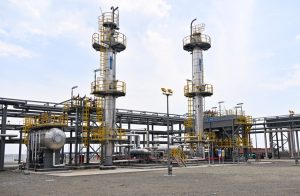
At the CPF, crude oil, water, gas and waste will be separated. Produced water will be reinjected into the reservoir, waste will be transferred for treatment, while associated gas will be directed towards power generation and LPG production.
The processed crude will then be transported through the feeder pipeline to Pump Station 1 before entering the 1,443-kilometre EACOP for onward transportation to Tanga.

CNOOC promises sustainable development
CNOOC Uganda Limited President Liu Xiangdong said the progress at Kingfisher reflected years of work and cooperation between the company and the Ugandan government.
“Your Excellency, when we look around Kingfisher today, we can see how far this project has come. What we see here is the result of many years of hard work, partnership and commitment. It is also a reflection of the support and guidance we have received from the Government of Uganda,” Xiangdong said.
“Our objective is simple: to develop the resource while living in harmony with the environment and the communities around us,” he added.
He said the Kingfisher project also demonstrated the growing Uganda-China partnership through investment, technology and technical expertise.
“CNOOC Uganda Limited remains committed to working with the Government of Uganda, its partners and the communities around Kingfisher to deliver a safe, responsible and sustainable development that creates lasting value for Uganda,” Xiangdong said.
The Kingfisher crude is waxy and has a low sulphur content. Because it can solidify at normal temperatures, it will require heating throughout transportation.
The crude will eventually move through EACOP to Tanga Port in Tanzania. Batebe said construction of the pipeline had reached 92.7 per cent completion.