



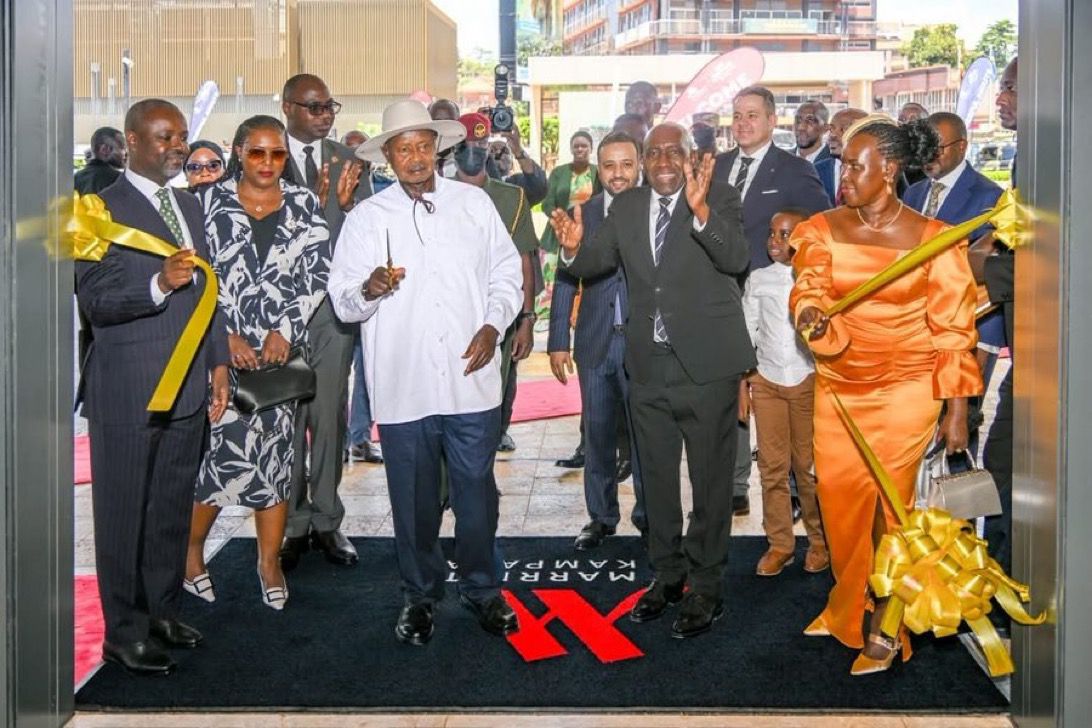
KAMPALA — President Yoweri Kaguta Museveni has called for greater emphasis on wealth creation and domestic production, arguing that African economies cannot achieve sustainable development by focusing on infrastructure while neglecting the creation of productive wealth.
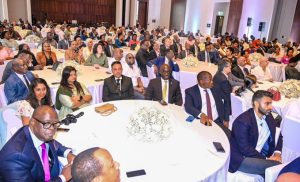
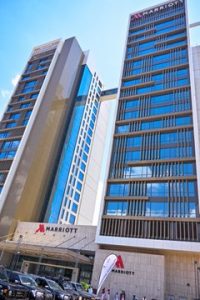
Museveni made the remarks on Thursday while officiating at the grand inauguration and key handover ceremony of the Kampala Marriott Hotel and Marriott Executive Apartments Kampala in Nsambya, Makindye Division.
The President used the investment to illustrate what he described as Uganda’s desired transition from an import-dependent economy to one increasingly driven by local production, investment and value addition.
“Many of the African economies have not grown because of the mistakes of the leaders. They fail to distinguish between development and wealth,” Museveni said.
He argued that while development is often measured through infrastructure such as roads, sustainable economic transformation ultimately requires people and businesses to create wealth.
Museveni identified commercial agriculture, services, ICT and manufacturing as the four key sectors that should drive wealth creation in Uganda.
He congratulated Ponsiano Ngabirano, Chairman of Capital Shoppers Ltd, for growing his business from a small grocery shop in Nakasero into a major investment in Uganda’s hospitality industry through the Marriott-branded development.
The President particularly highlighted Ngabirano’s transition from importing milk to distributing locally produced milk.
“I want to congratulate Mr. Ngabirano, from being an importer to now an internal distributor,” he said.
Museveni said the journey demonstrated how Ugandan businesses could begin by importing goods while progressively moving towards domestic production.
He cited Nigerian businessman Aliko Dangote, who initially imported cement before becoming a major manufacturer and later expanding into the petroleum sector, as another example of the transition.
“Importers, provided you are clear with our strategy, you will progress well,” Museveni said.
He said Uganda should encourage investors to move beyond importing finished products and instead establish manufacturing capacity, creating jobs, expanding the tax base and increasing national production.
The President also welcomed the National Social Security Fund’s investment in the hotel, arguing that investing workers’ savings in productive domestic projects provides greater economic value than placing the funds in foreign assets.
“I am also glad to hear that NSSF has woken up and invested in this hotel, instead of investing that money in foreign bonds which do not add anything to our GDP,” he said.
Museveni also commended Cardinal Emmanuel Wamala for recognising the value of the investment and making land available for the project.
He welcomed Marriott International’s expansion into Uganda, saying the continent’s growing population presented opportunities for investment in tourism and hospitality.
“I am very glad to see that Marriott is beginning to see where the market potential is, because the African population is growing rapidly,” he said.
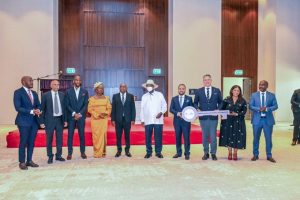
Marriott expands Uganda’s hospitality capacity
The Kampala development combines the Kampala Marriott Hotel and Marriott Executive Apartments Kampala, offering 181 hotel guestrooms and suites and 96 fully serviced apartments.
The hotel has six restaurants and bars, wellness and business facilities and 1,293 square metres of meetings and events space, including the Kampala Grand Ballroom, which can accommodate up to 985 guests.
The investment has created more than 350 direct jobs, with about 95% of employees being Ugandan nationals. More than 120 women work across the two properties, while approximately 90% of procurement is locally sourced.
The opening marks the debut of the Marriott Hotels and Marriott Executive Apartments brands in Uganda and brings Marriott International’s presence in the country to seven properties across five brands.
Finance, Planning and Economic Development Minister Henry Musasizi described the development as evidence of Uganda’s growing appeal as an investment and tourism destination.
Musasizi said qualifying new investments benefit from a 10-year tax holiday, with corporate income tax becoming applicable once an investor begins generating profits.
He said the hotel would contribute to the economy through employment, tourism and increased economic activity.
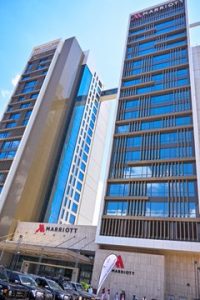
With more than 250 accommodation units across the hotel and serviced apartments, Musasizi said the development would strengthen Uganda’s capacity to accommodate tourists, business travellers and international events.
He, however, identified skills development as an area requiring greater investment, particularly because of the limited number of specialised institutions training hospitality workers.
Musasizi pledged to work towards expanding training opportunities while encouraging private investors to support hospitality skills development.
“Establishing such an investment in Uganda shows a vote of confidence in Uganda,” he said.
He commended Capital Shoppers for undertaking the project and Marriott International for partnering with the Ugandan company to establish and operate the facility according to international standards.
Marriott promises community investment
Marriott International Regional Vice President for Sub-Saharan Africa Johan Cronjé said the company had witnessed significant growth since entering Uganda and commended the Government for supporting tourism and hospitality.
Cronjé said Marriott’s business philosophy extends beyond accommodation and food services to caring for employees and supporting communities where it operates.
He said the company plans to contribute to community initiatives, including school infrastructure and other social projects.
“Uganda’s tourism sector continues to demonstrate strong momentum, supported by growing visitor demand, investment and infrastructure development,” Cronjé said.
He said the new development would increase internationally branded accommodation, create employment and strengthen Kampala’s capacity to host conferences, business meetings and international events.
Ngabirano asks government to review hotel taxes
Ngabirano thanked Museveni for officiating at the opening and attributed the growth of Capital Shoppers to what he described as Uganda’s peace, stability and conducive investment environment.
“What started as a small grocery in Nakasero turned into a supermarket and now we are opening a big franchise. It was because of your clean leadership, Your Excellency,” Ngabirano said.
He said the hotel currently employs about 400 people and could employ more than 1,000 by the end of the year.
Ngabirano also thanked the Ministry of Finance for its support during construction and NSSF for investing 30% in the project.
He, however, used the occasion to raise concerns about taxation in the hospitality industry, saying high taxes were affecting the competitiveness of hotels.
Speaking on behalf of the Uganda Hotels Association, Ngabirano called for a review of taxes imposed on hotels and increased investment in hospitality training.
He also appealed for more land for hotel development, including along the Kampala-Entebbe corridor, to attract additional hospitality investments.
Ngabirano said about 97% of Marriott’s employees are Ugandan nationals, underscoring the project’s contribution to local employment.
The opening comes as Uganda’s tourism sector continues to expand. The Uganda Tourism Statistical Abstract 2025 reported that tourism generated Shs5.8 trillion (US$1.62 billion) in earnings during 2025, contributed an estimated 5.9% to GDP and supported more than 876,000 jobs.
The Marriott properties are also partnering with universities, hospitality colleges and technical institutions to provide internships and training opportunities.
The investment thus arrives carrying two different arguments at once: Marriott sees Uganda as a growing market; Museveni sees the hotel as another step in the country’s movement from consumption towards production.
The harder question is whether Uganda can turn investments like this into a wider industrial and productive economy — one in which capital does not merely circulate, but creates wealth, jobs and local value.