


In Part Three of Guardians of Kikurungo, I introduced you to my uncle, Ishaka Nterwa, the guardian of the cattle; the man who understood that a herd was never merely a collection of animals, but a living archive of family, memory, wealth and belonging.
Part Four
The Kingdom of Horns: When Cattle Became Family
In Kikurungo, cattle were never just animals. They carried family names, memories, pride and identity. Among them was a legendary herd — and within it, extraordinary creatures whose stories still live.
By Rogers Atukunda
*
The first kingdom I ever knew was not built with stones.
It had no walls.
It had no throne.
It had no army.
Its citizens walked on four legs, carried magnificent horns and filled the landscape with a quiet dignity.
It was the kingdom of cattle.
Before I understood the language of heritage, I understood it through the eyes of the long-horned cattle standing beneath the morning sun.
I was taught to love them as family, refer to them as memory, and cherish them as wealth, identity and responsibility.
In the hills of Kikurungo, cattle were not merely possessions. They were part of the family story.
A herd carried memories.
A cow carried a name.
A bull carried a reputation.
A calf represented the future.
To an outsider, a kraal might appear to be a simple enclosure where animals rested at night.
But to us, it was much more.
It was an archive.
It was a bank.
It was a classroom.
It was a place where generations connected.
The Longhorns: More Than a Breed
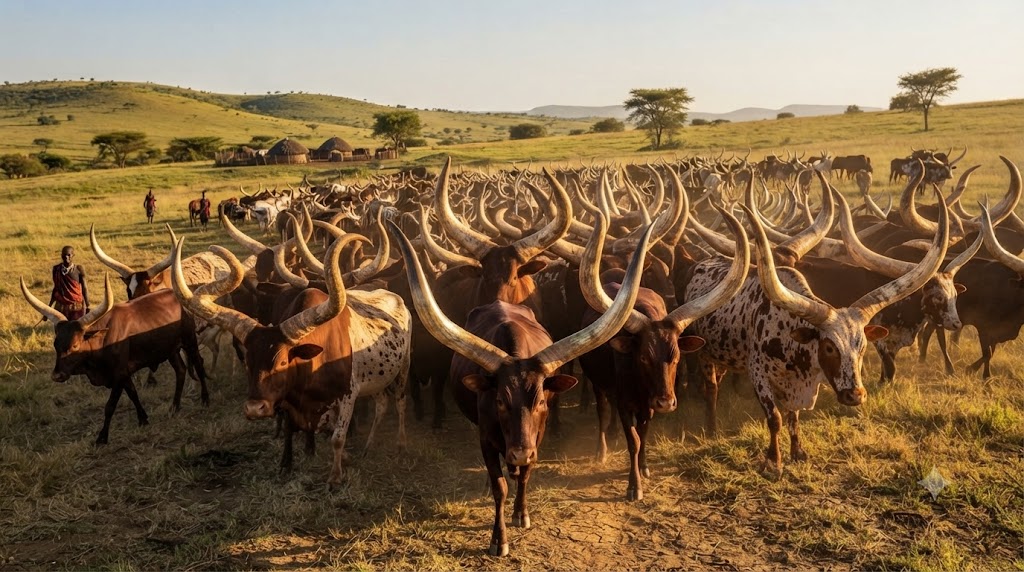
Among all the animals that shaped my childhood, none carried the identity of our people more powerfully than the long-horned cattle.
Their beauty was impossible to ignore.
They stood proudly with their long, curved horns reaching toward the sky.
Their coats carried different shades — white, cream, brown, black and combinations that made every animal unique.
They looked almost mythical.
But their importance went beyond appearance.
The cattle represented a relationship between people and land.
They represented patience.
They represented survival.
They represented the understanding that wealth is not only measured by what can be sold, but by what can be preserved.
My grandparents did not see cattle as machines for production.
They saw living beings that had been entrusted to them.
A Cow Was Never Just a Cow
One of the greatest lessons from the old cattle culture was that animals had personalities.
People knew their cattle.
They knew their temperaments.
They knew their strengths.
They knew their weaknesses.
A cattle keeper could identify an animal from a distance.
He knew the sound of its movement.
He knew its behaviour.
He knew when something was wrong.
The relationship was almost conversational.
The animal communicated.
The human listened.
This knowledge was not written in books.
It was inherited through generations of observation.
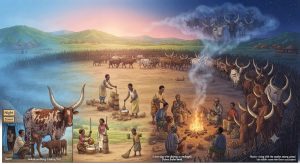
A cow was not owned; it was known
The cows were not livestock as classified today.
They were members of the family.
But most importantly, they were individuals.
They had different names.
They had different colours.
They had different horns.
Some were beautiful.
Some were feared.
Some were celebrated around the evening fire.
And some carried lineages that could be traced back through generations simply by speaking their names.
In my grandmother’s world, a cow was never simply a cow.
She taught me that a cow was not owned; it was known.
A cow could be named for the colour of its coat, the pattern on its body, the shape of its horns or some distinctive physical mark.
There were names such as Bihogo, Ngabo, Siina, Gaju, Kyozi, Kiroko, etc.
Bihogo was especially cherished. Its reddish-brown or chestnut colour was considered beautiful, and the name itself became associated with a cow that was admired and beloved.
Kiroko could describe a dark or black-coated cow. Enjeru, or Njeru, referred to a white or light-coloured one. Rusiina could describe a dark red or brownish-red shade. Ngabo evoked the appearance of large, distinct patches, while Mpuura could refer to striped or multi-coloured patterns.
The vocabulary was richer than I understood as a child.
The cows were being described, remembered and classified through the language of the people who knew them.
And they knew them intimately.
My grandmother could call a cow by its name, and it would come out of the herd and step forward.
She would then stroke it, speaking softly to it as if it was a human being.
That still amazes me.
Among people who kept cattle, recognition went both ways.
We knew the animals, and they knew us.
A name was not merely a label attached to an animal. It was part of a relationship.
In the evening, around the fire, the cows could become the subject of conversation.
Their beauty was praised.
Their strength was remembered.
Their peculiarities were recounted.
Their victories and defeats were retold.
Their descendants were identified.
The story of a cow could stretch backwards through generations.
I remember expressions such as “Kayenje ka Mayenje ga Ngabo ya Bihogo.”
To someone unfamiliar with cattle genealogy, it might sound like an ordinary description. But it carried a lineage.
Kayenje (heifer) the daughter of Mayenje who was a daughter of Ngabo, and Ngabo who was a descendant of Bihogo.
In a few words, an entire family tree could be spoken.
This was how cattle history was preserved.
Not in registers.
Not in databases.
Not in photographs.
It lived in memory and language.
A person who knew the cattle well could look at an animal and tell you who its parents were, where it came from, what its ancestors looked like and sometimes what they were remembered for.
The Language of Horns
The horns too had their own language.
Long, white and curved, they rose from their heads and caught the light from a distance; some cattle had no horns at all, but the horned ones were the animals the eye remembered.
They carried their horns as though they had been given them for a purpose older than ours.
A cow was not simply described as having “big horns” or “small horns”.
The shape, direction and character of the horns could tell a knowledgeable cattle keeper something about the animal before the animal had even moved.
There were different forms.
Some horns swept out straight and pointed, resembling the traditional throwing spears (amacumu).
Some were elegant, curved and opened outward in a broad arch.
Some were distinctive because their tips curved inward towards each other, forming something like a heart.
Other horns grew differently.
They dropped downward alongside the face instead of rising proudly above it.
Others pointed almost straight upwards, forming a high, narrow V.
Others spread widely sideways, almost horizontally, giving the animal an imposing breadth.
Then there were the unusual ones.
Some cows carried asymmetrical horns, where one horn grew in a noticeably different direction from the other.
And there were cows with very short or stunted horns.
But perhaps the most spectacular were lyre-shaped horns that swept outward before rising elegantly upwards.
To a child, these were simply beautiful animals.
To the cattle keepers, they were something more.
They were reading a language.
A man’s knowledge of cattle was not measured only by how many animals he owned. It was also measured by whether he could look at one and understand what he was seeing.
He could recognise the colour.
The markings.
The horns.
The lineage.
The temperament.
The history.
And sometimes, before anyone said a word, the animal’s appearance had already told him a story.
That is the knowledge I grew up around.
I did not know that one day I would struggle to find words for it.
I simply knew that cows spoke to people who knew how to look and listen.
The Language of Cattle
In Kikurungo, cattle were companions in the story of a family.
A herd was a living history.
A child could know the cows by their names, their colours, their personalities and their movements. The cattle were not silent possessions standing in a kraal. They were individuals.
Some were gentle.
Some were stubborn.
Some were fighters.
Some carried the pride of the family.
The adults understood every animal had a character.
As children, we absorbed that knowledge naturally.
Nobody sat us down and explained:
“Today you will learn animal behaviour”.
We learned because we watched.
We learned because we followed.
We learned because someone trusted us enough to walk among animals that carried value beyond money.
The cattle taught responsibility.
A cow was not only something you received.
A cow was something you guarded.
A cow was not simply an animal that could be sold.
It was connected to memory.
It was connected to family identity.
It was connected to the people who had cared for it before.
The Rhythm of the Kraal
A kraal (orugo) is a traditional African enclosure for livestock, such as cattle, sheep, or goats.
It is built using wood, logs, or thick thorn bushes to keep animals safe at night.
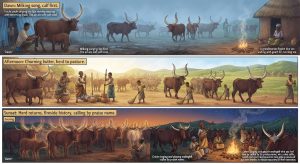
In Kikurungo, the kraal was one of my childhood classrooms.
Before sunrise, before the world became busy, the cattle already had their own rhythm.
The sounds were familiar.
The movement of animals.
The voices of people calling them.
The smell of fresh milk.
The dust rising beneath their feet.
The quiet preparation for the day.
These moments taught discipline.
Cattle cannot be rushed.
They cannot be treated carelessly.
They demand consistency.
Okukama (Milking)
My grandparents kept two herds.
The first remained below the hill.
These were the milk cows.
Milking happened at dawn and dusk.
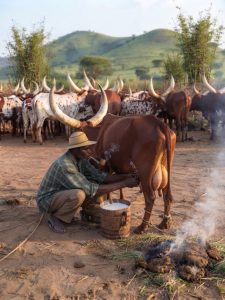
Before the first light reached the hills, my uncle Ishaka Nterwa would already be inside the kraal.
A small fire burned slowly beneath the cattle. He fed it with dry cow dung and sweet-smelling grass whose smoke drifted gently around the animals, driving away flies and calming restless mothers.
Each cow was brushed clean.
Each cow knew its place.
Each knew my uncle’s voice.
He never called them simply “cow”.
Every one carried a praise name inherited from her colour, her horns, her temperament or the family she descended from.
He spoke those names softly, almost like greetings between old friends.
Then he whistled.
Even today I cannot remember all the words.
Only the feeling.
His whistling floated through the mist while calves tugged impatiently against their ropes.
Before milking began, each calf was allowed to suckle.
Just for a moment.
Enough for the mother to believe her child had returned.
The calf would latch onto one teat.
Then another.
Before drinking properly, it was gently pulled away.
The udder softened.
Milk descended.
Only then would my uncle crouch beside the cow, tying her hind legs loosely with a short rope (emboha) so she would not accidentally kick the gourd.
The rhythm began.
Milk striking the sides of the wooden vessel.
A steady music.
The first song of every morning.
When he finished, he never emptied the udder.
The calves still had to feed.
That, too, was guardianship.
Taking only what belonged to you.
Eshabwe (ghee)
The women carried a different kind of knowledge.
Their classroom was the kitchen.
Their laboratory was fire.
Their instruments were gourds, clay pots, calabashes and patient hands.
Fresh milk rarely stayed fresh for long.
By the following morning it had already begun another journey.
While we milked, my aunties would already be waiting in the kitchen.
They poured the milk into a long-necked calabash blackened by years of smoke.
They added herbs whose names I only half remember now.
A little dark mineral salt.
Then they sealed the mouth of the calabash.
Shake.
Shake.
Shake.
The milk slapped against the sides of the calabash with a dull rhythm.
Back and forth.
Back and forth.
Until suddenly everything changed.
The sound became softer.
Heavier.
They would then open the calabash.
Golden butter (amazuta) floated to the top like a small miracle.
It would then be scooped gently into another vessel.
Nothing in that kitchen ever seemed to appear by accident.
Transformation always demanded patience.
That was only half the journey.
My aunties would later add certain herbs and salt to the butter.
They would repeat the shaking routine, again and again.
And then a whitish sauce emerged.
That delicacy was called eshabwe (ghee).
This is one of the richest sauces I have ever tasted.
It was usually served with steaming millet bread.
The Child Who Thought He Was Herding
Just like my uncle and my grandfather before him, I also aspired to become a herdsman.
The mornings belonged to the cows.
The afternoons belonged to the hills.
By the time the milk had been carried back to the kitchen, my uncle would already be searching for his herding stick.
I was always waiting.
Sometimes I arrived before him, holding a stick I had cut myself from bamboo that grew beautifully beside the kraal. It was crooked, far too short and peeled unevenly where I had hacked at it with a blunt knife. To me, it looked exactly like the stick of a real herdsman.
My uncle examined it without laughing.
“It will do,” he said.
Those three words made me feel taller than the hill itself.
The cattle left the kraal in no particular hurry. They knew the path better than any of us. Their bells rang lazily as they climbed towards the hill, stopping now and again to nibble at tender shoots beside the footpath.
I walked behind them with all the seriousness of a man entrusted with a kingdom.
The cows ignored me completely.
They only obeyed my uncle.
Not me.
At first, that wounded my pride.
I thought carrying a stick was enough to make me a herdsman.
It wasn’t.
Authority, I would learn much later, is not something you hold in your hand. It is something others place in you.
The goats were even less impressed.
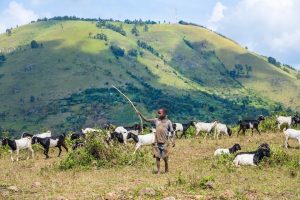
Grandmother kept hundreds of goats and sheep alongside her cattle, and on days when my uncle had other work, I insisted that I could take them grazing by myself.
No one argued.
Perhaps they knew the hill would teach me what they did not have to.
The goats streamed out of their enclosure as though I did not exist.
They did not wait for instructions.
They did not look back.
They scattered across the hillside, painting it black and white, each following paths it had walked hundreds of times before.
I chased after them, shouting and waving my little stick.
Nothing changed.
They grazed where they wished.
Rested where they wished.
Drank when they wished.
The only creature convinced I was in charge was me.
Years later I laughed whenever I remembered those afternoons.
I had believed I was taking the goats grazing.
In truth, the goats were taking me.
They introduced me to hidden footpaths, wild berries and quiet streams that no map could ever show.
They knew the hill far better than I did.
And the hill, as I would soon discover, had lessons of its own.
Okweshera
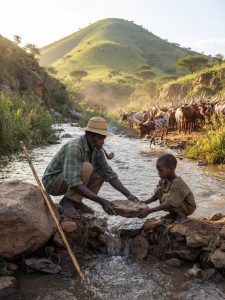
Taking cattle to drink (okweshera) was itself a ceremony.
My uncle led the herd to a stream flowing from Kikurungo hill.
At a place called Kanyanseko, he would arrange stones across the stream to create a temporary dam.
“Today, you help me make water”.
I laughed.
The river was flowing only a few metres away.
How could anyone make water?
He did not answer.
Instead, he stepped into the shallow stream and began lifting stones from the riverbed.
Large stones.
Small stones.
Flat stones that fitted neatly against one another.
I jumped in beside him.
The water was so cold that my feet ached.
Together we carried stone after stone until they stretched across the stream.
Slowly, almost gradually, the water began to rise.
The current slowed.
A clear pool formed behind the little wall we had built.
My uncle smiled.
“Now bring the cows”.
The cattle entered one by one, lowering their enormous horns as they drank.
The water reached their knees.
The calves splashed.
When the last cow had finished drinking, my uncle pulled away a few stones.
The water rushed forward again, continuing its journey down the hill.
Nothing permanent had been built.
Nothing had been taken from the river.
We had only borrowed it for a little while.
Years later, after hearing endless arguments about dams, rivers and development, I often found myself remembering that afternoon.
My uncle never tried to conquer the river.
He worked with it.
Perhaps that is another way of describing wisdom.
The Guardians of the Herd
A herd survived because someone cared.
This was the responsibility of the cattle keeper.
The guardian of cattle was not simply someone who watched animals.
They were responsible for life.
They protected against disease.
They searched for lost animals.
They ensured calves survived.
They understood the landscape.
They knew where water was found.
They knew which pastures were safe.
In many ways, the cattle keeper was an environmental guardian before the modern language of conservation existed.
The Super Herd
My grandparents’ second herd lived atop Kikurungo hill.
It was this herd that captured my imagination.
It lived high above us in a place called Kinyamugara.
That was the super herd.
It was under the guardianship of my grandfather.
Those cattle belonged to another world.
There the grass was taller.
The silence older.
The grazing range stretched endlessly.
Those cattle roamed freely across vast grasslands, sharing the landscape with buffaloes, kobs, antelopes, zebra and other wild animals.
As a child, I thought they belonged to another world—a place where the wild and the domestic lived side by side.
My grandmother often told me about her legendary breeding bull.
He was not simply the strongest animal in the herd.
He was its guardian.
On quiet nights, when predators crept silently toward the kraal, the bull would sense them long before anyone else. He would lower his massive head and let out a deep, thunderous bellow that rolled across the hills.
That sound was the alarm.
The herdsmen would wake immediately, grab their spears and fire sticks, and race toward the kraal to drive the predators away.
Long before electric fences, security lights, or surveillance cameras, the cattle had their own protector.
Looking back now, I often wonder whether the old people understood something we are only beginning to remember — that these animals were never just livestock.
They were companions.
They were protectors.
They were part of the family.
The Guardian Bull
Every great kingdom has its legendary figures.
The cattle kingdom of my childhood had them too.
There were animals whose names remained long after they disappeared.
Animals whose stories were repeated because they represented something larger than themselves.
The breeding bull of my grandparents’ herd was one of those legends.
He was not simply a bull.
He represented pride.
Strength.
Lineage.
The continuation of a family legacy.
A breeding bull carried responsibility for generations that would come after him.
His role was not measured only by his physical strength.
It was measured by what he gave the future.
I have spent years trying to remember whether my grandmother called him Ruhogo or Rusiina.
Memory, like old cattle paths, sometimes disappears beneath new grass.
For now, we will call him Ruhogo.
Ruhogo and the Lion
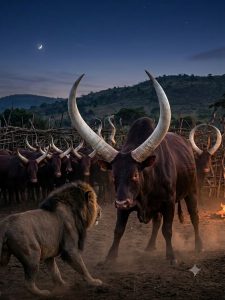
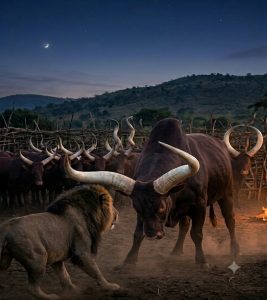
One night, while the guardians rested at Kinyamugara, a male lion approached the kraal determined to kill the prized bull.
The story I was told is that instead of retreating, the bull turned the stick-and-wattle enclosure into a fighting ring.
The kraal was built from thorn branches and heavy poles, strong enough to discourage leopards, hyenas and thieves, but a determined lion fears little.
Inside the enclosure, the cows panicked.
They surged from one side of the kraal to the other, their bells clanging wildly.
Then something extraordinary happened.
The bull gathered the cows into the centre of the enclosure.
Not by force.
By presence.
He walked slowly around them, placing himself between the herd and the lion.
His horns lowered.
His nostrils flared.
He sneezed violently into the cold night air.
Then came a long, thunderous bellow that rolled across Kinyamugara.
As it patrolled the perimeter, its head remained lowered, horns pointed toward the lion.
It snorted violently, pawed the ground, bellowed again and challenged the predator.
Neither animal backed down.
The standoff continued until my grandfather and the herdsmen emerged from their grass-thatched huts.
They released the hunting dogs, forcing the lion to retreat.
The chase continued through the night.
The next morning, the lion lay where the dogs had finally brought him down.
The Fear of Losing a Kingdom
Today, when I look at the changing relationship between Ugandans and indigenous cattle, I feel a sense of concern.
The world is changing.
Farming systems are changing.
Economic pressures are changing.
And slowly, some traditions are disappearing.
My fear is not only that a breed of cattle may decline.
My fear is that a philosophy may disappear with it.
The philosophy that animals are not only economic assets.
The philosophy that heritage has value.
The philosophy that some things should be protected because they tell us who we are.
The longhorn is not just a cow.
It is a living memory.
The Responsibility Passed Down
My grandparents’ generation understood something that modern society sometimes forgets:
Not everything valuable can be measured by money.
Some things are valuable because they connect us.
A herd connects generations.
A seed connects generations.
A hill connects generations.
A story connects generations.
The responsibility of each generation is not only to consume what it receives.
It is to protect what it inherits.
That is guardianship.
When I think about the cattle of Kikurungo today, I do not only remember animals.
I remember a way of seeing the world.
A world where humans were not owners of nature, but caretakers within it.
A world where a kraal could become a classroom.
A world where horns carried history.
A world where a child could learn from a cow.
*
From Ruhogo, I learned that leadership is pure service: putting the lives of others above your own.
But if Ruhogo taught me how to lead, another cow would later teach me what it means to hold authority.
Such a cow being none other than;
Kasa: The Princess of the Herd.
Next Tuesday in The Guardians of Kikurungo
Part Five: Kasa — The Princess of the Herd