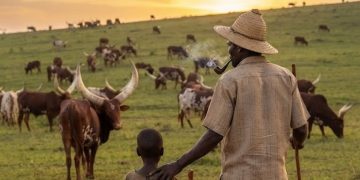



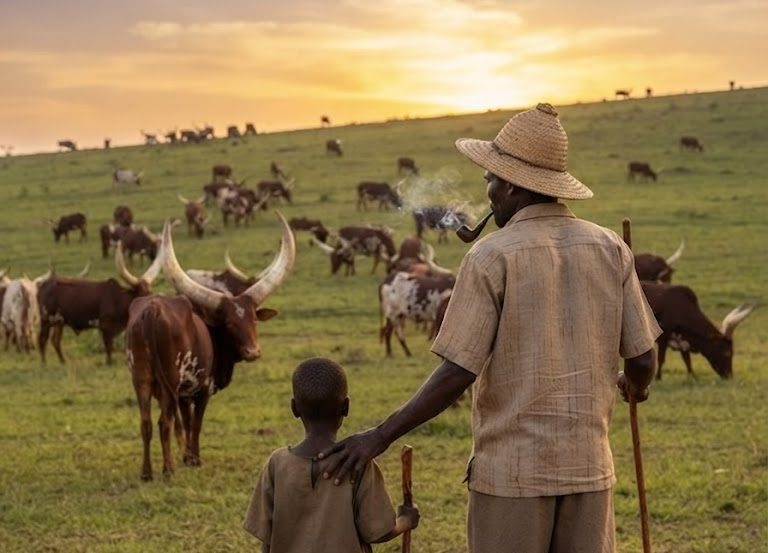
In Part Two of Guardians of Kikurungo, I introduced you to my grandmother, Zeluya Kantooma — the woman with the orubango who taught me the first and deepest meaning of guardianship. When she left this world, her lessons did not leave with her. They lived on in the people she had shaped, among them her son, my uncle, Ishaka Nterwa.
This is his story.
Part Three
Ishaka Nterwa: The Guardian Who Needed No Classroom
He was born a fighter and raised to become a protector. He never called himself a teacher, but the lessons he passed on through action shaped my understanding of courage, responsibility and survival.
By Rogers Atukunda
*
There are teachers who carry books.
There are teachers who carry titles.
And there are teachers who carry scars.
My uncle, Ishaka Nterwa, belonged to the third kind.
He was raised by hardship and transformed by responsibility.
He never stood before a blackboard, yet he taught lessons about courage, protection and duty that remained long after childhood ended.
He was not a man who announced that he was teaching you.
He did not gather children around him and deliver lessons. He did not explain the principles of courage, responsibility or survival.
He simply lived them.
And if you were fortunate enough to watch him closely, you learned.
In the world of Kikurungo, where knowledge travelled through observation and experience, Ishaka was one of those rare people whose life itself became a classroom.
He was born a fighter.
But he was not born to fight for himself.
He was raised to become a guardian.
A Fighter Forged by the Hills
The hills of Kikurungo created people who understood struggle.
Life was not separated into neat categories of comfort and hardship.
People worked.
They endured.
They protected.
They adapted.
The land demanded strength.
The cattle demanded patience.
The seasons demanded resilience.
In such a world, a person’s character was not measured by what they claimed to be.
It was measured by what they did when responsibility arrived.
That was Ishaka.
He was a man shaped by the expectations of his environment.
A person who understood that strength was not a gift to display.
Strength was a duty.
Ishaka had walked beside his mother Zeluya for years, absorbing not only her words but also her way of seeing the world.
He understood the language of the cattle, the rhythm of the seasons, the stories behind our family, and the responsibilities that came with our inheritance.
In him, my grandmother’s knowledge did not end; it continued its journey.
Watching them together, I came to understand that inheritance was never only about land or cattle.
The greatest inheritance was memory itself—carefully handed from one generation to the next, guardian to guardian.
And through my uncle, that chain of guardianship would one day reach me.
The Smoking Pipe
My uncle was famous for his smoking pipe.
It seemed almost like an extension of him.
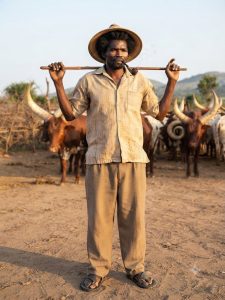
He smoked tobacco regularly and carried his pipe wherever he went.
Every morning, he would pick it up, turn it upside down and tap it gently against a hard surface, emptying the ash and residue left from the previous night’s smoke. Once it was clean, he would place it between his lips as naturally as if it belonged there.
I watched him closely.
He would take a dry tobacco leaf, crush it between his fingers and pack it into the pipe. Then he would pick a glowing ember from the fire and touch it to the tobacco. A moment later, he would draw deeply.
A thick cloud of smoke would roll from his mouth.
Sometimes, to my delight, he would play with the smoke, puffing it out in different shapes as though he were performing a small magic trick just for me.
As a child, I found all of this fascinating.
Naturally, I wanted to be like him.
One day, I decided to make my own pipe.
I took a piece of dry banana leaf and rolled it carefully. I crushed some dry tobacco into powder and stuffed it inside, copying the way my uncle always did it.
Then I lit one end.
I placed the other end in my mouth and took a puff.
The smoke hit my throat and lungs like a punishment.
I choked.
I coughed.
I coughed some more.
I have no memory of what happened immediately afterwards.
The next thing I remember—or what I was later told—is that my aunties found me deeply asleep on the veranda.
My eyes had turned red.
That was when I swore never to smoke again.
It is an oath I have kept to this day.
*
My uncle did not only smoke tobacco.
Sometimes, he smoked another kind of leaf whose name I did not know as a child.
It grew around the homestead. It was different from tobacco—darker, stronger-looking, carrying a mystery I was too young to understand. Some people in our community cultivated it for medicinal purposes.
Whenever my uncle smoked that leaf, something dramatic happened to his eyes.
They turned red.
And after that, trouble seemed to know where to find him.
At the tonto (local brew) drinking joints, a quarrel could become a fight in seconds.
Ishaka never seemed to notice the odds.
While other men gathered themselves into groups, he could stand alone and take on a dozen of them, as though numbers were nothing to him.
Yet there were occasions when even Ishaka did not stand alone.
Another formidable figure often took his side. This was a relative I could never quite place.
The Relative Who Was Both Uncle and Aunt
As a child, I could not tell whether this person was a man or a woman.
The face looked feminine to me, but there was a beard growing across it. The body was broad and solid, more like a man’s. Yet the face kept pulling my mind in the other direction.
I remember wondering which title I was supposed to use.
Eventually, I asked an elder.
“Is he an uncle or an aunt?”
The answer only deepened the mystery.
“Both. He is an uncle and an aunt.”
That was all I was told.
No explanation followed.
As often happened with children in those days, the adults seemed to consider the matter settled. We were expected to accept what we had been told and move on.
So I did.
I never learnt the person’s name in a way that has survived in my memory. What remained was the strange certainty that somewhere in our family there was a person who was both uncle and aunt.
But if the person’s place in the family tree confused me, there was nothing confusing about the person’s courage.
At the tonto drinking places, where men could turn an argument into a fight in the time it took to empty a cup, this person often stood beside my uncle Ishaka.
And whenever this duo joined the same fight, the numbers hardly seemed to matter.
They could mulch their opponents like dry grass.
I remember those fights as part of the mythology of Ishaka’s world—the hills, the drinking places, the men who gathered there, and this unusual relative who would appear beside him when trouble began.
Looking back now, I realise how little I understood about this person.
I did not know the biology.
I did not know what questions the adults themselves may have been unable or unwilling to answer.
I only knew what I could see: a face that confused me, a beard that made the confusion deeper, a body that seemed masculine, and an elder’s simple answer that somehow made room for everything:
uncle and aunt.
The Education of Action
Looking back, I understand that my uncle’s greatest lessons were never spoken.
He taught by doing.
When he worked with cattle, he was teaching responsibility.
When he protected the homestead, he was teaching courage.
When he solved problems, he was teaching resourcefulness.
When he faced danger, he was teaching that fear and bravery can exist together.
Courage is not the absence of fear.
Courage is deciding that something else matters more.
The Tree That Became a Blanket
There was a special kind of fig tree we called omutooma.
It was not an ordinary tree.
It grew tall and hard, with a thick trunk and a heavy bark.
The elders treated it with a kind of reverence.
You did not simply walk up to an omutooma and cut it down because you needed firewood or wanted to clear the land. It was understood to be useful, and useful things were treated with respect.
I learned this from watching my uncle Ishaka.
When he wanted to make bark cloth, he did not cut down the tree.
He measured the section of bark he needed and made two horizontal cuts around the trunk, one above and one below, forming a broad circular band. The size depended on how much bark he wanted.
Then he waited.
A whitish sap began to ooze from the cuts and run down the trunk.
After allowing the tree to release its sap, he made a vertical opening through the marked section.
Then came the part that fascinated me most.
With special tools, he began peeling the bark away from the tree.
He could work clockwise or anti-clockwise, depending on how he approached it.
Slowly, the bark separated from the trunk.
It came away in one piece.
That was what amazed me most as a child. Something that appeared so firmly attached to the tree could be removed carefully without being torn into pieces.
Once the bark was off, Ishaka placed it across a large log.
Then he began to beat it.
He used a wooden hammer with an enormous flat head.
Thump.
Thump.
Thump.
The sound continued for hours.
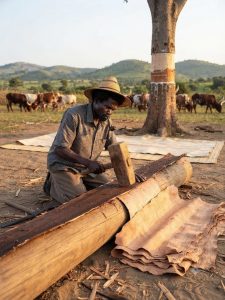
The bark gradually changed beneath the hammer.
It softened. It widened. It stretched in both directions until what had initially looked like a thick strip of tree bark became a broad sheet.
The work required patience.
No shortcut.
When the bark had been sufficiently softened and stretched, it was spread out to dry in the sun.
As it dried, its colour changed.
The pale material developed a deep, warm terracotta hue.
It was the colour of earth baked beneath a generous sun, holding a quiet warmth that caught the eye.
It didn’t shout; it simply settled into a rich, cinnamon rust that felt entirely timeless.
Looking at it, you couldn’t help but feel a sense of grounding comfort, as if the very spirit of the tree had softened into something cosy enough to wear.
It could become a mattress.
It could become a blanket.
It could become clothing.
As a child, I watched all this without understanding that I was witnessing an entire technology.
I only knew that my uncle could take something from a tree and turn it into something people could sleep on, cover themselves with or wear.
A Fire Without Matches
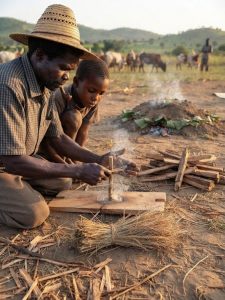
I always followed my uncle whenever he went grazing.
After the cattle had been put to pasture, he would then make a fire.
But he did not need a matchbox to make it.
I watched him do it many times, and each time it seemed almost like magic.
He would find a small, completely dry stick and gather dry grass and pieces of firewood.
He placed the dry grass over the wood, then positioned the small stick against it.
Holding the stick firmly between his palms, he began to rub his hands back and forth, making the stick spin rapidly against the wood.
At first, nothing happened.
Then came a faint thread of smoke.
I would move closer.
He kept rubbing.
The smoke thickened.
And then, almost suddenly, there was fire.
He would gently feed the tiny flame with dry grass, coaxing it rather than overwhelming it.
Once it caught properly, he transferred it to another bundle of dry sticks and built the fire until it was strong enough for cooking.
Sometimes we roasted potatoes, matooke or cassava.
But my uncle had another way of cooking that fascinated me even more.
He would prepare what we called ekyikomi, a kind of earthen mound oven.
Once the firewood had burned down sufficiently, the food would be wrapped in green leaves and placed among the hot embers. Then soil was heaped on top, covering the food and the remaining heat.
Then we waited.
There was no frantic boiling.
No saucepan rattling over a stove.
No timer.
The earth itself became the oven.
Slowly, underneath the mound, the heat travelled through the food until the potatoes, cassava or matooke were cooked.
When the mound was finally opened, the smell of roasted food and warm earth rose together.
My uncle knew how to work with what the landscape provided.
Dry wood.
Dry grass.
Green leaves.
Soil.
Heat.
He did not need electricity.
He did not need manufactured equipment.
He did not even need a matchbox.
He understood the materials around him well enough to make them cooperate.
That was another kind of education.
The Meaning of a Guardian
When I look back now, I realise my uncle represented the true meaning of guardianship.
Today, the word “guardian” often makes us think of someone appointed to look after another person.
But in Kikurungo, guardianship was much bigger.
A guardian was someone who stood between danger and those who depended on them.
A guardian protected children.
A guardian protected cattle.
A guardian protected the home.
A guardian protected the traditions of the family.
A guardian did not wait for recognition.
They acted because action was necessary.
The Men Who Understood Animals
One of the greatest differences between generations is the relationship with animals.
Today, many people see animals through categories.
Livestock.
Pets.
Wildlife.
Property.
But in the world I grew up in, animals occupied a more complicated place.
They were companions.
They were responsibilities.
They were part of the family story.
A cattle keeper knew his animals.
He understood their moods.
He understood their movements.
He understood when something was wrong.
My uncle carried this knowledge.
He belonged to a generation that could read the language of animals.
A restless cow.
A nervous herd.
A barking dog.
A strange silence in the night.
Everything communicated.
The Cost of Guardianship
But guardianship is not always heroic.
Sometimes it is lonely.
Sometimes it demands things that others never see.
The person protecting others must often carry burdens quietly.
They wake up earlier.
They work longer.
They face dangers others avoid.
They accept responsibility without applause.
That was the nature of people like Ishaka.
They did not ask:
“What do I gain?”
They asked:
“What needs to be done?”
The Day the Cheetah Came
When my grandfather died, the guardianship of the cattle passed to my uncle.
Although he was the only boy among about seven sisters, he was never raised to believe that being the only son made him special.
Not on my grandmother’s watch.
She had no patience for softness.
She was raising a guardian.
Responsibility was his inheritance.
And he grew into a fighter.
He fought men at beer gatherings when honour demanded it.
But more importantly…
He fought the wild.
The same landscape that sustained the cattle constantly tested those who protected them.
In those days, the relationship between people and the wild was closer.
Animals were not distant creatures seen only in protected areas.
They were neighbours.
Sometimes peaceful.
Sometimes dangerous.
The cattle kraal was not only a place of wealth.
It was a place that had to be defended.
*
One day, a cheetah had been stalking the herd.
Patient.
Silent.
Waiting.
Then it struck at a dizzying speed.
It seized one of the calves.
When Ishaka rushed to protect it, the cheetah turned on him.
The battle that followed lived in family memory long before it lived in mine.
The story that remained with us was that he strangled the cheetah with his bare hands.
My uncle never personally told this story; all he showed me was the cheetah’s skin hanging on his doorway.
He never spoke much about courage.
Perhaps courageous people rarely do.
Someone else always told the story.
How the cheetah sprang.
How there was no time to reach a spear.
How man and animal rolled together.
How two hands found a cheetah’s throat.
How the cheetah’s sharp claws dug into his skin and tore flesh.
How neither intended to surrender.
Until, finally, the great cat yielded, its powerful spirit slipping away into the quiet.
Every family has one story that slowly becomes legend.
Whether told as a family memory, a village legend or a symbol of his character, the meaning was always the same:
Ishaka was someone who stood between danger and what he loved.
The Guardian of the Family Lessons
As a child, I did not know I was witnessing a philosophy.
I thought I was simply watching my uncle.
A strong man.
A hardworking man.
A fearless man.
But adulthood reveals things childhood cannot.
I now understand that people like Ishaka were the bridges between generations.
They carried knowledge from the past and transferred it through example.
They showed younger people what responsibility looked like.
They showed us that protecting something requires sacrifice.
The Last Stories of Ishaka Nterwa
For many people, the final days of life are moments of silence.
For Ishaka Nterwa, they became a time of storytelling.
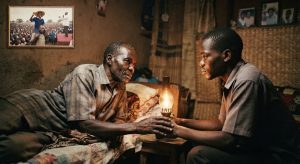
As his health declined in the mid-2000s, Ishaka spent his last days sharing memories of a life shaped by hard work, community service and the traditions of his people.
He was in his late fifties—still energetic and known for his strength—but years of demanding physical labour, poor eating habits and health complications had weakened him.
During his final days, I sat beside him.
It was during those quiet moments that Ishaka opened a window into a past I had never known.
He recalled his youthful adventures, including a visit to Masyoro (lake George) with its landing site Kayinja, where he attempted to learn fishing.
The fishermen, following their traditional initiation practices, threw him into the water as part of his introduction to the craft and the challenges of life on the lake.
He also spoke with pride about his contribution to his community, including being part of the team that helped construct some of the buildings at Kicheche Sub- County headquarters.
But among all his memories, one was unforgettable—the day he helped a young boy witness history.
In the early 1990s, President Yoweri Kaguta Museveni visited Kitagwenda, drawing thousands of residents to Kicheche Sub- County.
At the time, Museveni was still widely associated with his liberation struggle years and his rise from the bush to the presidency.
I, then in lower primary school, had left my parents’ home in Kashangura and joined the massive crowd gathered to see the President.
Lost among the many people, my uncle was able to find me.
Rather than taking me back home, he bought me pancakes, lifted me onto his shoulders, allowing his nephew to see above the crowd and catch a glimpse of the President.
Later, when children were invited closer to President Museveni, I was among those who sat at the front, near the President, watching the cultural performances prepared for the occasion.
I also remember the excitement after the President’s helicopter took off from Kicheche Primary School grounds. Some residents rushed to the spot where it had landed and pulled pieces of grass, believing it would bring good fortune.
When I returned home that evening, my parents were astonished by my daring adventure.
They could hardly believe their young son had managed to disappear into the crowd, meet his uncle and end up sitting near the President.
My punishment was only two strokes of the cane.
Years later, as Ishaka lay on his deathbed, we revisited that memory together.
Only later did I understand that those conversations were more than family reminiscences.
Ishaka, the only son of Zeluya Kantooma—a phenomenal woman whose life carried generations of Kitagwenda history—was passing on a responsibility.
Through his stories, Ishaka became the bridge between his mother’s generation and the next.
He was not only sharing memories.
He was handing over a legacy.
My grandmother had taught him how to guard the stories of our people.
He had carried them until his final days.
Now, they were coming to me.
The Man Who Became a Lesson
Years later, when I think about the people who educated me, I include my uncle among my greatest teachers.
Not because he gave speeches.
Not because he wrote books.
But because he showed me something important:
A person’s greatest legacy is not what they own.
It is what they protect.
My grandmother taught me generosity.
The hills taught me belonging.
But Ishaka Nterwa taught me courage.
He showed me that guardianship is not a word.
It is a responsibility carried by people who are willing to stand when others cannot.
Before I understood the guardianship of landscapes, traditions and heritage, I first saw it in a man.
A man who fought predators.
A man who protected cattle.
A man who carried strength quietly.
A man who never needed a classroom to become a teacher.
His name was Ishaka Nterwa.
The Guardians in Four Legs
Perhaps one of the greatest lessons of my childhood was that guardianship was not only a human responsibility.
It was the law of life.
The animals around us also had roles.
The dogs guarding our home were not simply pets.
They had personalities.
They had reputations.
They had duties.
Even the animals we feared taught us something.
The aggressive ones taught us caution.
The playful ones taught us companionship.
The stubborn ones taught us patience.
In that world, animals were not decorations around human life.
They were part of the family story.
*
Among the most significant animal guardians of Kikurungo were the cattle.
They had been there before I understood what they meant.
They had names. Families. Temperaments. Histories.
They knew the hills better than we did.
And perhaps, in their own way, they had been guarding us too.
Ishaka remains memorable not because of his brute strength and courage but because of the immeasurable value of what he protected:
The Cattle. The Magnificent Longhorns.
*
Next Tuesday in The Guardians of Kikurungo
Part Four: The Kingdom of Horns — When Cattle Had Names and Legacies