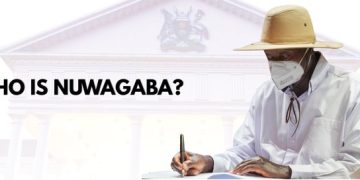




KAMPALA — President Yoweri Kaguta Museveni has defended Stephen Nuwagaba, a young man at the centre of a controversy over alleged influence within State House and security circles, saying he came to him as a victim of torture and threats rather than as a security risk.
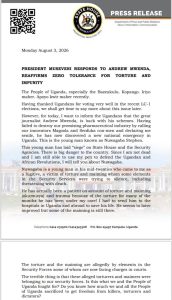
In a lengthy statement titled “Response to Mwenda on the Issue of Stephen Nuwagaba,” President Museveni responded to allegations raised by journalist Andrew Mwenda, accusing him of creating a “national emergency” around Nuwagaba while ignoring what he described as deeper problems within security institutions.
President Museveni said Nuwagaba, whom he described as being in his mid-twenties, had sought his help after allegedly suffering torture and maiming by elements within the security services.
“Nuwagaba is a young man in his mid-twenties who came to me as a fugitive, a victim of torture and maiming, whom some elements in the Security Services were trying to silence, including threatening him with death,” President Museveni said.
He added that Nuwagaba had received medical treatment locally and abroad because of injuries and trauma allegedly resulting from the abuse.
“He has actually been a patient on account of torture and maiming, and trauma because of the torture, for many of the months he has been under my care,” he said.
The President said the alleged perpetrators were some members of security forces and that investigations had been initiated.
“The torture and the maiming are allegedly by elements in the Security Forces, some of whom are now facing charges in courts,” he said.
President Museveni accused Mwenda of focusing on Nuwagaba’s access to State House and security agencies instead of investigating alleged misconduct by security personnel.
“The reality on the ground is that the main problem of Uganda is not Nuwagaba seizing State House and the Security Forces, but the criminals, including some in the Security Forces and other organs, that have been blocking the flow of information about the criminals,” he said.
Defence of security institutions
President Museveni said while Uganda’s security forces had been instrumental in maintaining stability, some individuals within them had become corrupt or abused their positions.
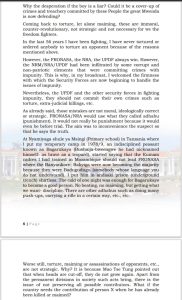
“The NRM/NRA/UPDF had been infiltrated by some corrupt and non-patriotic elements that were committing crimes with impunity,” he said.
He warned security agencies against committing abuses while fighting crime.
“Nevertheless, the UPDF and the other security forces, in fighting impunity, should not commit their own crimes, such as torture, extra-judicial killings, etc.”
The President linked his position on torture to the history of Uganda’s liberation struggles, recalling killings during the regimes of former President Idi Amin and the violence experienced during the Luwero Triangle conflict.
He said those who fought for Uganda’s liberation did not do so to see citizens suffer similar abuses again.
“All these people did not suffer so that Ugandans are tortured, maimed or traumatised, again,” President Museveni said.
Criticism of Mwenda
President Museveni accused Mwenda of pursuing what he called “schemes” against his administration, citing previous criticism of government initiatives and leaders.
“The great journalist Andrew Mwenda is back with his schemes,” he said.
He accused the journalist of attempting to distract the country from corruption and criminality within institutions.
“The evil schemes of Mwenda are always seeking to disorient the focus of the country to trivialities, or to covering up crime, as could be the case in this matter,” he said.
The President questioned why investigative attention was not instead focused on issues such as corruption in government programmes and infrastructure projects.
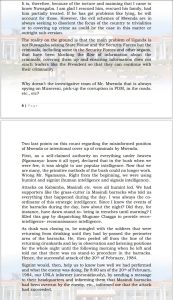
“Why doesn’t the investigative team of Mr Mwenda, that is always spying on Museveni, pick up the corruption in PDM, in the roads, etc.?” he asked.
Intelligence networks
In responding to arguments about informal intelligence channels, President Museveni said his movement had historically relied on both human intelligence and signals intelligence during the liberation struggle.
He rejected claims that informal intelligence methods were outdated, saying they had contributed to past military successes.
“Right from the beginning, we were using humint and signint (human intelligence and signals intelligence),” he said.
He cited examples from the National Resistance Army bush war, including operations around Kabamba and Masindi barracks, where he said intelligence gathering played a critical role.
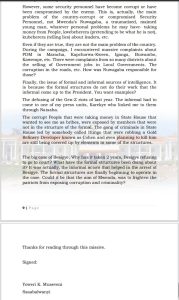
President Museveni argued that informal sources sometimes approach leaders because official systems fail to provide accurate information.
“It is because the formal structures do not do their work that the informal come up to the President,” he said.
Calls for investigation
The President said Nuwagaba’s personal conduct, including any possible wrongdoing, could still be investigated if allegations against him were proven.
“If he has got problems like lying, he will account for those,” he said.
However, he maintained that such issues should not overshadow what he described as the larger concern of security personnel accused of committing crimes.
President Museveni said further details about the matter would be provided later, adding that investigations into the allegations were ongoing.
“We shall get time to say more about this issue later,” he said.