


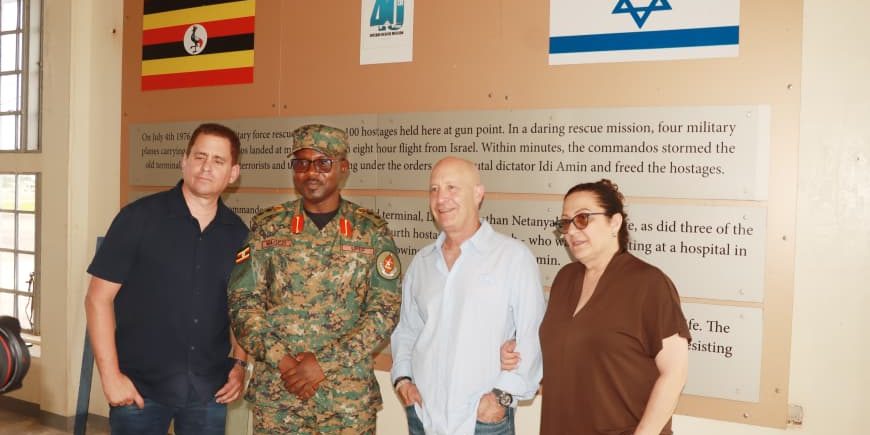
ENTEBBE — Nearly five decades after surviving one of the world’s most famous hostage crises, three former Israeli hostages have returned to Uganda and revisited the old terminal at Entebbe International Airport, where they were held during the 1976 Air France hijacking.
The visitors — Benny Davidson, who was 13 years old at the time, Shay Gross, then aged six, and Tzipi (Cohen) Gonen, who was eight — walked through the historic site where they spent several traumatic days as captives before a dramatic Israeli military rescue operation brought the ordeal to an end.
The delegation was received by the Acting Director of Defence Public Information, Colonel Chris Magezi, who welcomed them back to Uganda and reflected on the historical significance of the site.
For the former hostages, the visit was an emotional journey back to a defining moment in their childhoods. “The moment I walked in, the memories came back as if it was yesterday. I could still picture everything clearly,” Davidson said.
The Air France Airbus A300 had been hijacked on June 27, 1976, while travelling from Tel Aviv to Paris via Athens by militants affiliated with the Popular Front for the Liberation of Palestine–External Operations and two German accomplices.
After initially being diverted to Libya, the aircraft was flown to Uganda’s Entebbe Airport, where additional hijackers joined the group. The hostages were held at the old airport terminal while negotiations continued.
Over the following days, non-Israeli passengers were released, while Israeli passengers and members of the Air France crew remained in captivity.
The crisis ended in the early hours of July 4, 1976, when Israeli commandos launched the now-famous Operation Entebbe, also known as Operation Thunderbolt, rescuing the majority of the hostages in a military operation that remains one of the most studied counterterrorism missions in modern history.
For Gonen, returning to the scene brought back painful memories, including the loss of her father during the operation.
“My father was shot dead. My brother was missing at the time. In the confusion of the exchange of fire, I never knew whether he was killed by Ugandan soldiers or during the rescue operation,” she said.
She described the visit as a deeply personal pilgrimage that allowed her to honour her father’s memory and find a measure of closure after carrying the trauma for nearly half a century.
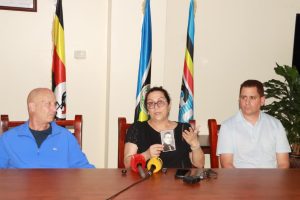
Gonen said she had lived with the memories since childhood and only recently found the courage to openly discuss her experience.
Davidson noted that Uganda today bears little resemblance to the country he remembered from 1976.
He praised the warm reception accorded to the delegation and observed significant changes in the country’s institutions, including the military.
Speaking during the visit, Col Magezi said Uganda welcomes visitors who wish to learn more about the events that unfolded at Entebbe and their place in world history.
“Uganda is open, welcoming, and ready to receive anyone who wishes to visit the old terminal, where these events once took place,” he said.
He described the hostage crisis as one of the most difficult chapters in Uganda’s history and a landmark event in the global fight against terrorism.
According to Col Magezi, the successful rescue operation demonstrated that terrorism can be defeated through determination, professionalism and international cooperation.
He also highlighted Israel’s resilience in overcoming repeated security challenges throughout its history, noting that the events of 1976 continue to offer important lessons about peace, security and international collaboration.
Today, the old terminal building at Entebbe remains a place of historical significance, drawing visitors from around the world who seek to understand the events that unfolded there.
For Davidson, Gross and Gonen, however, the site is more than a historical landmark. It is a place where childhood memories of fear, uncertainty and loss remain etched in time — memories that, as Davidson put it, returned “as if it was yesterday.”