



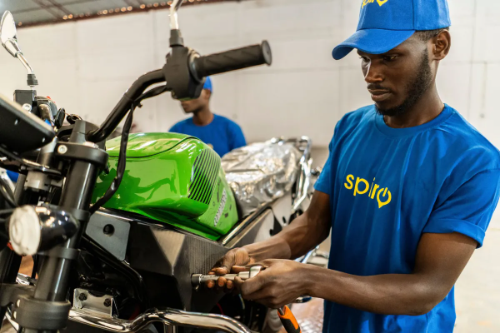
Spiro has secured a landmark $215M investment round backed by major institutional investors, including Impact Fund Denmark and Equitane.
According to Spiro, the investment will support the expansion of Spiro’s battery-swapping network, strengthen its industrial and assembly footprint, accelerate technology development, and support the company’s entry into new high-growth African markets.
As African economies push to reduce dependence on imported fuel, reinforce energy and industrial sovereignty, and modernise urban transport systems, global investors are increasingly turning to scalable EV infrastructure platforms.
Building on the support of long-standing institutional partners such as FEDA, Spiro’s latest equity round draws global capital from Europe and Africa, confirming growing global confidence in scalable, infrastructure-led business models across emerging markets.
Following years of optimisation across its product portfolio, technology, and energy ecosystem, Spiro has moved past the proof-of-concept phase. He stands ready to execute the next chapter of pan-African expansion.
As Africa’s urban population and mobility needs continue to surge, electric vehicles and battery-swapping ecosystems are rapidly emerging as one of the continent’s most promising infrastructure and energy investment opportunities.
“We are investing in Spiro and bringing Danish pension capital into one of Africa’s most promising growth markets because we see potential for significant commercial growth in Spiro and electric mobility across Africa, as well as measurable climate impact. That is exactly the type of investment we want to make,” says Lars Bo Bertram, CEO of Impact Fund Denmark.
Reducing dependence on imported fuel, strengthening energy and industrial sovereignty, and modernising urban transport systems are becoming strategic priorities across the continent, positioning EV infrastructure as a key pillar of Africa’s economic resilience and industrial development.
Driven by rising fuel costs, growing demand for affordable transportation, and expanding policy support for clean energy solutions, investors are backing scalable EV platforms to support Africa’s next phase of urban and industrial growth.
For riders, the economic impact is immediate: operating a Spiro electric vehicle can reduce daily mobility costs by up to 40%, generating savings of up to $2 per day compared to fossil-fuel motorcycles.
Recent third-party verified lifecycle assessment results conducted on Spiro’s operations in Kenya further highlight the environmental impact of EV infrastructure deployment across African cities.
Spiro’s electric bikes delivered a 72% reduction in climate impact compared to fossil-fuel motorcycles, equivalent to approximately 19 tons of CO2 emissions avoided over a vehicle’s lifespan.
The study also identified an 80% reduction in ozone depletion potential and a 20% reduction in particulate matter emissions, underscoring the role electric mobility can play in improving urban air quality and reducing public health risks across rapidly growing cities.
“This past year marked a defining strategic milestone for Spiro. Across seven active markets, our deployment of 100,000 electric vehicles and 2,500 smart-swap stations has turned sustainable mobility into an affordable, everyday reality. Spiro has become a major driver of local industrialisation, value creation, and manufacturing across African markets with 6,000 sustainable direct and indirect jobs. Supported by our global pool of investors, we are entering our next growth chapter to deliver clean, cost-effective energy and transport alternatives to millions of riders across the continent,” stated Gagan Gupta, Founder of Spiro and Chairman of Equitane.
With operations across 7 African markets: Kenya, Rwanda, Uganda, Togo, Benin, Nigeria, and Cameroon, and further plans to expand local production and enter new markets such as DRC and Ethiopia, Spiro is building one of Africa’s most advanced EV and battery-swapping ecosystems.
Spiro’s industrial footprint includes flagship manufacturing plants in Kenya, Rwanda, and Uganda, alongside a state-of-the-art battery recycling facility in Nigeria. Combining locally adapted vehicle design, affordable battery-swapping infrastructure, and integrated maintenance ecosystems, Spiro is making electric mobility commercially viable at scale for African riders.
Spiro’s technology platform is supported by its R&D centre, 150+ engineers, and 30+ proprietary patents. The company is actively expanding beyond urban transport into a distributed clean-energy utility network that supports national renewable energy goals while reducing dependence on imported fossil fuels.
Its innovations include IoT-enabled, solar-powered swap stations, alongside secondary-life battery applications designed for stationary renewable energy storage.
Since the closure of the Strait of Hormuz, Spiro riders are driving real change.
Making an irreversible impact with fuel saved per day: 675,000 litres and 4,725,000 litres weekly, and 20,250,000 litres monthly.
Per Day: $1.11M saved on the 675,000 litres of fuel. Weekly: $7.78M saved on 4.7M litres of fuel. Monthly: $33.35M saved on 20.3M litres of fuel.