


The government of Uganda has stepped up efforts to protect the ecologically significant Bugoma Central Forest Reserve following its official handover from the National Forestry Authority (NFA) to the Uganda Wildlife Authority (UWA).
The transition, presided over by Prime Minister Robinah Nabbanja in Kikuube District, follows a directive issued on February 23, 2026, by President Yoweri Kaguta Museveni. The directive aims to halt environmental degradation, evict encroachers, and strengthen long-term conservation of the forest.
This followed growing concerns over the rapid destruction of Bugoma Forest, which has in recent years faced intense pressure from illegal logging, charcoal burning, land encroachment, and settlement expansion.
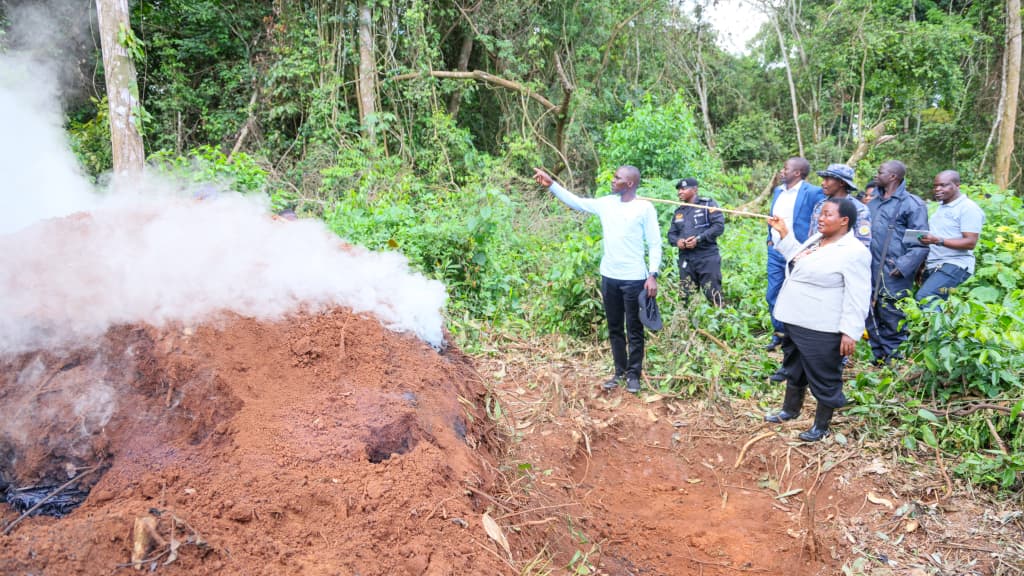
Ahead of the official handover, Nabbanja, accompanied by Tourism Minister Tom Butime and UWA leadership, conducted an on-site inspection of affected sections of the forest.
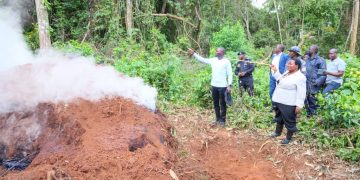
The team encountered widespread deforestation, degraded habitats, and ongoing illegal activities within protected zones. Two suspects were arrested during the operation, signalling a shift toward stricter enforcement.
“The destruction we have witnessed here is unacceptable,” Nabbanja said, warning that continued degradation threatens biodiversity, undermines tourism potential, and disrupts livelihoods that depend on the forest ecosystem.
Nabbanja expressed confidence in UWA’s institutional capacity, citing its track record in protected area management, law enforcement, and ecological restoration.
She directed the Ministry of Tourism, Wildlife and Antiquities to fast-track the process of upgrading Bugoma into a national park, an elevation expected to enhance protection and position the forest as a key eco-tourism destination.
The Prime Minister also ordered the immediate eviction of all encroachers without compensation and called for the cancellation of illegally acquired land titles within the forest boundaries. Relevant agencies, including the Ministry of Lands, were tasked with reopening boundaries and supporting enforcement efforts.
Following the handover, UWA has deployed personnel to strengthen surveillance, enforce conservation laws, and prevent further illegal activities within the reserve.
UWA Executive Director James Musinguzi said the authority has moved swiftly to take control of the forest.
“We have received this responsibility as directed by the President, and deployment is already underway. Our teams are on the ground to ensure security and stop any encroachment,” he said.
Musinguzi noted that enforcement efforts will include ground patrols, drone surveillance, and aerial monitoring to detect and deter illegal activities.
He added that UWA will work closely with district leaders, local communities, and other stakeholders to ensure effective and inclusive management of the forest.
“We will collaborate with the Ministry of Lands to clearly open and mark boundaries. Anyone found within the 44,162 hectares will be required to vacate once demarcation is complete,” he said.
UWA is expected to undertake a comprehensive ecological assessment to determine the level of degradation and guide restoration efforts.
A General Management Plan will also be developed in consultation with stakeholders to ensure sustainable use of forest resources while prioritising conservation. Planned interventions include public sensitisation campaigns through radio, community meetings, and district engagements.
Minister Butime described the handover as a milestone in Uganda’s environmental protection efforts. “This marks a critical step in safeguarding one of our most important ecosystems. UWA has the experience and technical capacity to restore and protect Bugoma for future generations,” he said. He further echoed the directive to flush out all encroachers.
Local leaders welcomed the government’s intervention, calling for clear boundary demarcation to prevent land conflicts and proposing measures such as electric fencing to manage potential human-wildlife conflict.
They pledged full cooperation with UWA, emphasising that protecting Bugoma is vital for both environmental sustainability and community well-being.
Bugoma Forest remains one of Uganda’s most important natural assets, serving as a biodiversity hotspot, a carbon sink, and a critical water catchment area within the Albertine region.