



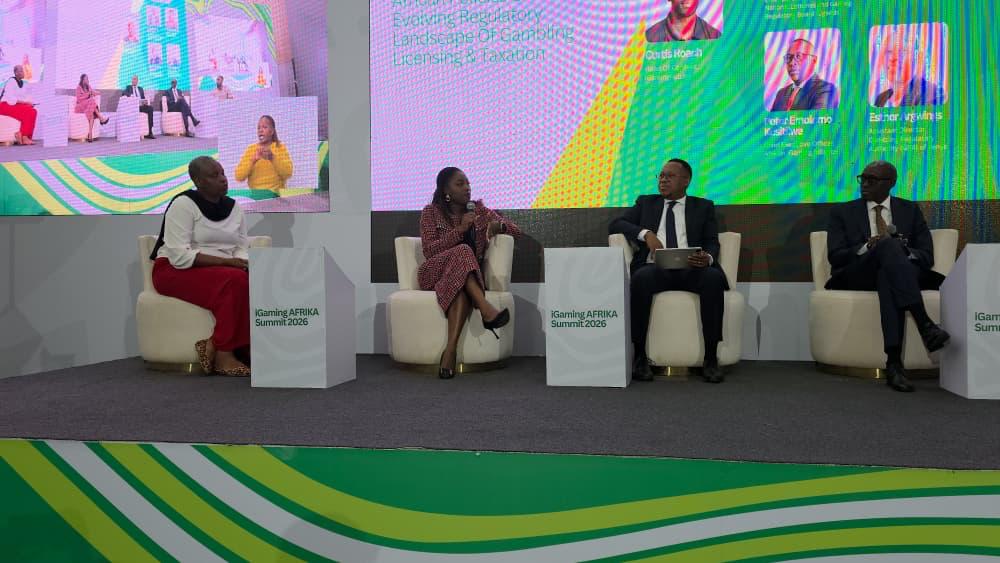
Uganda’s National Lotteries and Gaming Regulatory Board (NLGRB) CEO, Denis Mudene, has called for the establishment of an East African Gaming Regulators Forum as a practical step to harmonise responsible gaming standards and strengthen cross-border enforcement against illegal gambling.
Speaking during a high-level panel discussion on Africa’s evolving regulatory landscape at the inaugural iGaming Africa Summit in Nairobi, Mudene said the pace of digital transformation in the sector demands closer coordination among regulators, warning that without shared standards and joint enforcement, illegal operators will continue to exploit regulatory gaps.
“The market is no longer confined within borders. Without coordination, illegal operators will continue to exploit regulatory gaps,” he noted.
The summit, which brought together participants from over 100 countries, reflects the growing scale of Africa’s gaming ecosystem, spanning operators, payment platforms, telecoms and technology providers.
The panel featuring key voices from across the continent’s regulatory and industry landscape, including Esther Argwings of Kenya’s Gambling Regulatory Authority, Olabimpe Akingba of the Association of Nigerian Bookmakers, Peter Emolemo Kesitilwe of the African iGaming Alliance and Denis Mudene, highlighted a growing consensus that the future of gaming regulation will depend on cross-border cooperation.
A dominant theme from the discussion was the increasing threat posed by illegal and offshore gaming operators, many of whom target African markets without licences or regulatory oversight.
Regulators say these operators undermine licensed businesses, expose consumers to risk and create significant tax leakages, while their cross-border nature makes enforcement difficult when countries act in isolation.
Uganda’s recent enforcement efforts highlight both the scale of the challenge and the urgency of coordinated action. Under Operation Mashine Haramu, authorities have confiscated more than 7,000 illegal gaming machines and shut down over 20 unlicensed websites.
“Illegal operators are not just a regulatory issue. They are a consumer protection issue and a revenue issue. When they operate outside the system, they undermine compliant businesses, expose players to harm and deprive governments of much-needed revenue,” Mudene said.
However, regulators at the summit were clear that national enforcement alone is no longer sufficient. There is a growing consensus that tackling illegal gambling will require shared intelligence, coordinated enforcement and stronger partnerships with telecom and payment providers to disrupt illegal activity.
The discussions also underscored how rapidly the industry is evolving, driven by mobile technology, digital payments and online platforms.
In Uganda, operators are now required to declare their software providers and demonstrate how their systems work, while the regulator has also moved to license software providers directly as part of efforts to strengthen oversight across the value chain.
Mudene emphasised that harmonisation does not mean imposing identical laws or tax regimes, but aligning on core areas such as responsible gaming, consumer protection and anti-money laundering standards.
“Harmonisation is not about making every country the same, but about aligning on the fundamentals that protect the player and the integrity of the market. If we can agree on those, we can close the gaps that illegal operators are exploiting,” Mudene said.
Panellists broadly agreed on the need for alignment in these areas, noting that even baseline coordination could significantly improve oversight. Standardising safeguards such as self-exclusion tools, deposit limits and age verification, for example, would make it harder for players to bypass restrictions by simply switching jurisdictions.