


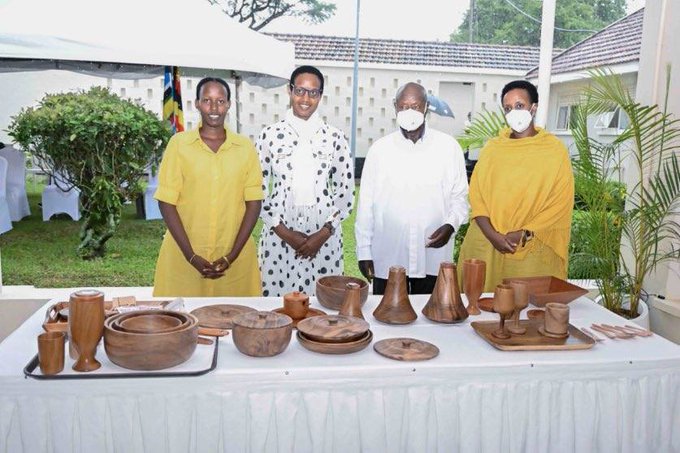
KAMPALA — President Yoweri Kaguta Museveni has officially endorsed the use of indigenous wooden crockery, following a comprehensive scientific assessment that found traditional timber containers safe for food use.
In a message shared on his official platform, the President said, “Fellow Ugandans, especially the Bazzukulu, following a scientific assessment by our CBRN team, I have written to Matongo Wood Works Company confirming that traditional wooden food containers made from omunyama (mahogany) and omusisa (albizia) are safe and durable.”
He added that government support would be extended to scale up production. “I have directed support for this initiative so that we free ourselves from the colonial habit of relying on fragile and unsafe ebyatika (the breakables),” Museveni stated.
Scientific validation
The directive follows a detailed toxicological study conducted by Uganda’s Chemical, Biological, Radiological, and Nuclear (CBRN) unit. The assessment examined handcrafted wooden containers made from mahogany and albizia, testing their interaction with different food types over a 12-hour period.
According to the March 2026 “Wooden Crockery Report Summary,” the findings confirmed zero toxicity, with no harmful compounds or heavy metals detected in either the wood or the food served on it. The materials also demonstrated strong resistance to heat and moisture.
The report noted a slight distinction between the two species: while albizia may release a harmless natural tint into liquids, mahogany showed no colour transfer, making it more suitable for soups and beverages.
‘Unbreakable’ heritage
In a formal directive issued from State House, Museveni described the initiative as part of a broader push toward economic self-reliance and cultural revival.
“Our indigenous knowledge systems served our people well for generations. It is time to consciously revive and promote them as part of building a self-reliant and modern Ugandan economy,” he said.
The President also shared a personal anecdote, revealing that he still owns a traditional wooden milk pot inherited from his grandfather, which has lasted more than eight decades.
“These were not inferior products. They were durable, safe, and part of our identity,” he noted, referencing traditional items such as ebyaanzi (milk pots), entaatika (bowls), and endosho (spoons).
Care and maintenance guidelines
Despite the positive safety findings, the report emphasises proper handling to maintain hygiene and longevity. Users are advised to wash the containers immediately after use with mild detergent, avoid prolonged soaking, and dry them in a shaded, well-ventilated area.
The study also recommends periodic conditioning with food-grade oils such as olive or linseed oil to preserve the wood and prevent cracking.
Policy direction
Museveni has since instructed the State House Comptroller to fully fund Matongo Wood Works Company to expand production capacity, describing the move as a step toward “liberating” Ugandans from reliance on imported or fragile kitchenware.
The initiative aligns with the government’s broader agenda to promote local industries and reduce dependence on foreign goods, while reviving traditional craftsmanship as a pillar of Uganda’s modern economy.