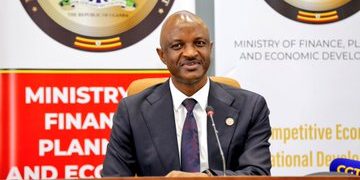



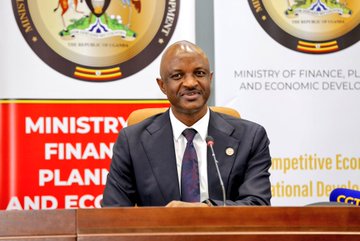
Uganda’s economy expanded by 8.5 percent in the second quarter of the Financial Year 2025/26, up from 5.4 percent recorded in the same period of FY 2024/25, according to preliminary estimates released by the Ministry of Finance, Planning and Economic Development.
Delivering the Quarterly Performance (Q4) press briefing, the Permanent Secretary and Secretary to the Treasury, Dr Ramathan Ggoobi, said the country is on a stronger growth path driven by improved economic activity across key sectors.
“The average economic growth for the first half of FY 2025/26, therefore, increased to 6.7 percent from 5.8 percent during the same period last year,” Ggoobi said.
He attributed the improved performance to rising aggregate demand, increased investment, and stronger exports, which have stimulated production across agriculture, industry, and services. “This strong performance was primarily driven by robust aggregate demand, investment and exports, reflected by increased production in the industrial, services, agriculture, forestry and fishing sectors of the economy,” he added.
According to projections, overall GDP growth is expected to accelerate further to 7.0 percent in FY 2025/26, compared to 6.3 percent in FY 2024/25, signalling continued recovery and expansion of economic activity.
By June 2026, Uganda’s Gross Domestic Product is projected to reach USD 68.4 billion (about Shs 251.4 trillion), or USD 194.2 billion in Purchasing Power Parity (PPP) terms. GDP per capita is also expected to rise to USD 1,399 (approximately Shs 5.03 million), reflecting gradual improvements in national income levels.
The Ministry of Finance, Planning and Economic Development noted that macroeconomic stability has remained broadly intact, with the Uganda shilling maintaining strong performance and inflation staying subdued at an average of 3.3 percent this financial year.
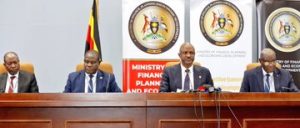
Dr Ggoobi said the positive indicators reflect prudent macroeconomic management and sustained policy discipline aimed at supporting long-term transformation.
“The Uganda shilling has performed strongly, reflecting prudent economic management, while annual headline inflation remains subdued, averaging at 3.3 percent this financial year,” he noted.
On fiscal policy, Dr Ggoobi said the fourth-quarter expenditure limits have been designed to balance growth ambitions with fiscal consolidation, in line with Uganda’s tenfold growth strategy.
He explained that the government is prioritising efficiency in spending while maintaining momentum in key growth sectors. “The quarter four expenditure limits have been informed by the need to sustain the momentum for implementation of the tenfold growth strategy, but within the framework of the fiscal consolidation agenda,” he said.
He added that government programming for FY 2025/26 is guided by four key principles: keeping expenditures within available resources, prioritising high-impact economic sectors, sustaining investment in growth enablers such as infrastructure and security, and ensuring minimum operational funding for government institutions.
These priorities, he said, are aligned with the ATMS framework—Agro-industrialisation, Tourism development, Mineral development, and Science, Technology and Innovation.
Dr Ggoobi also underscored the importance of human capital development, particularly health financing, during a keynote address at Makerere University School of Public Health Makerere University School of Public Health under the theme “Investing in health, Investing in Uganda’s future.”
“Health is not merely a social sector issue. It is an economic transformation issue, a productivity issue and a national competitive issue,” he said.
He emphasised that sustained investment in health and human capital remains central to achieving long-term structural transformation. “No country has achieved sustained structural transformation without sustained investment in human capital,” Ggoobi added.