


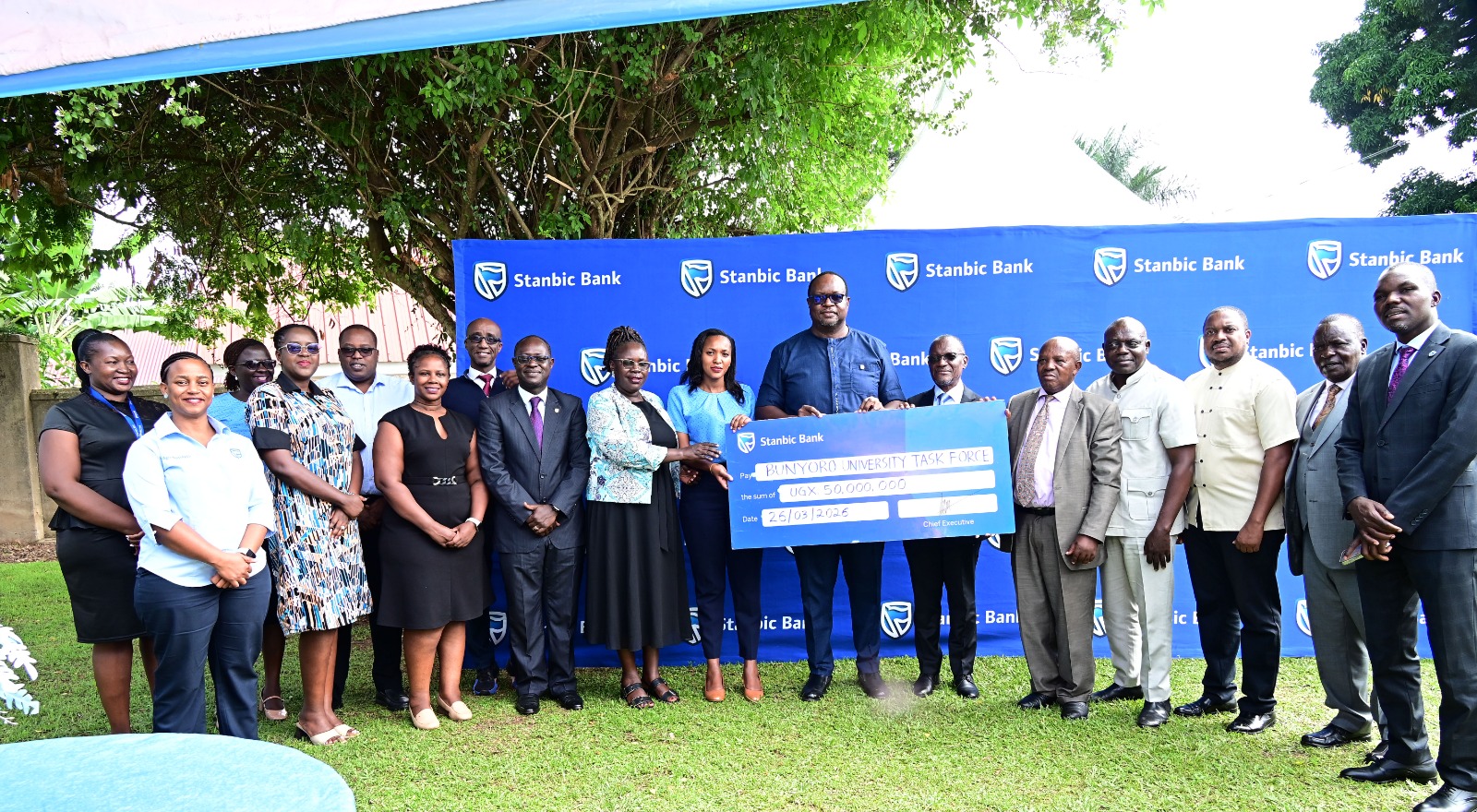
HOIMA — Stanbic Bank Uganda has contributed Shs50 million towards the establishment of an ICT innovation hub at Bunyoro University, becoming the first private sector entity to support the operationalisation of the institution.
The bank’s Chief Executive, Mumba Kalifungwa, handed over a dummy cheque to Prof. Samuel Kyamanywa during a ceremony held in Hoima City on March 26, 2026.
Kalifungwa said the contribution demonstrates the bank’s commitment to education as a key driver of national development, aligned with its broader positive impact agenda built on five pillars: financial inclusion, job creation, infrastructure development, climate resilience, and corporate philanthropy.
“Education is a core pillar in everything we do, accounting for about 70 per cent of our annual Corporate Social Investment budget,” he said. “We believe it is a critical engine for Uganda’s continued development and long-term economic sustainability.”
The funding will support the establishment of an ICT Maker Space—an innovation hub designed to serve as a centre for creativity, hands-on learning, entrepreneurship, and practical problem-solving for both students and the wider Bunyoro community.

Kalifungwa noted that the project aligns with the bank’s purpose—Uganda is our home, we drive her growth—which it pursues by empowering farmers, women, and young people through education, digital skills, and innovation.
“We hope that the innovation hub will serve as a centre for creativity, hands-on learning, and entrepreneurship,” he said, adding that the partnership is not only supporting the university’s establishment but also shaping “a future of opportunity, innovation, and shared prosperity.”
He described Bunyoro University as “a bold and transformative vision,” noting that its model—where 50 per cent of learning will be practical and community-based—will equip graduates with the ability to solve real-world challenges.
The university, which has already been accredited by the National Council for Higher Education, is expected to become fully operational next year, with its first intake anticipated in October 2027. It will launch with 18 science-based academic programmes aimed at equipping students with practical, industry-relevant skills to boost productivity and technological advancement in the oil-rich Albertine region.
Kalifungwa also revealed that Stanbic Bank has earmarked up to Shs1 trillion by 2028 to support local SMEs through incubator programmes, enhance financial inclusion through digitisation, and invest in education, health, and climate initiatives.
Prof. Kyamanywa welcomed the support, describing it as a timely boost towards establishing the university and preparing for its first intake.
“I pledge that the support you have given us will go towards its intended purpose of equipping the ICT innovation hub in the School of Computing and Information Sciences, which will be one of the first schools to be established,” he said.
He added that the Maker Space will nurture innovation and creativity while helping the university deliver on its mission of building relevant human capital for the region.
Kyamanywa revealed that the task force has already developed 18 academic programmes, alongside policies and guidelines required before the university can open.
“We have also fulfilled other requirements, including acquiring land for the university and getting a master plan for this land developed and approved,” he said. “The architectural and structural drawings and designs for the first four building blocks are ready. We are at the stage of procuring contractors.”
As the government mobilises resources for the next phases, he noted that there is room for more private sector support.
“Our partnership with Stanbic is the first, and the ICT innovation hub has the potential to stimulate innovation and youth empowerment,” he added.
Jacob Karubanga, the Member of Parliament for Kibanda South and Chairperson of the Bunyoro Parliamentary Caucus, praised the partnership, saying he was encouraged by the progress towards establishing a public university in the region.
Godwin Angalia, the Resident District Commissioner for Kikuube District, said that although the university is a government entity, it requires substantial stakeholder support to realise its full potential.
“The government may not be in a position to provide everything needed for the university. That is why partnerships like this are essential,” Angalia said. “Stanbic Bank has not waited for students to enter lecture rooms; they are ensuring that when students arrive, they find everything in place.”
He added that the university is a strategic investment aimed at harnessing the region’s oil and natural resources by developing a skilled workforce to support industrial growth.
Meanwhile, Brian Kaboyo, the Mayor of Hoima City, described the partnership as strategic for a region hosting major infrastructure projects such as Hoima City Stadium and Kabalega International Airport.
Stanbic Bank’s latest contribution adds to its long-standing involvement in national development initiatives, including the Stanbic National Schools Championship, which over the past decade has reached more than 600,000 students, supported over 500 schools, and led to the creation.