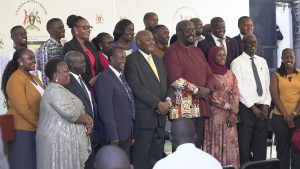



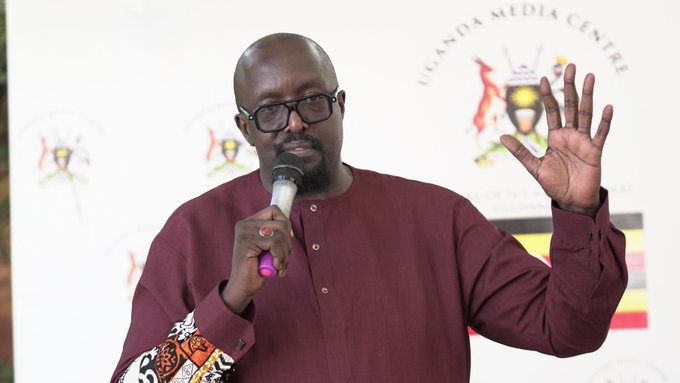
KAMPALA — Veteran broadcaster Alan Kasujja has officially assumed office as Executive Director of the Uganda Media Centre, pledging sweeping reforms to strengthen government communication, infrastructure, and professionalism.
Kasujja, a former BBC World Service lead presenter with over a decade of global experience, took over on Tuesday in Kampala. He replaces Ofwono Opondo, who resigned in April 2025 to pursue political ambitions.
Government communication is nation-building
In his inaugural address, Kasujja framed his new role as central to Uganda’s development agenda.
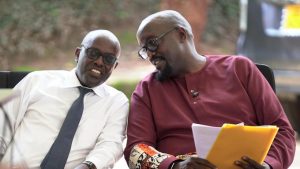
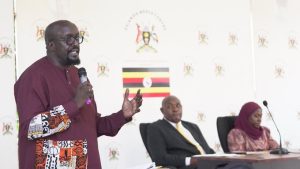
“I am going to serve this country with integrity, dedication, and purpose. We are going to build on what has already been built and turn what is already in place into an even more efficient machinery to speak for this country,” Kasujja said.
He emphasised that communication must go beyond public relations. “Government communication is not a PR exercise. It is nation-building, and this has to be taken very seriously,” he added.
Kasujja also stressed the urgency of coherent messaging across government institutions. “The government must speak with one voice. Fragmented messaging weakens efficiency, erodes public trust, and undermines credibility.”
Funding and infrastructure challenges
The new Executive Director called for increased and predictable funding to enable the centre to deliver on its mandate. “We don’t want to be begging you for money. We need this money so that we can do the work we’re supposed to do,” Kasujja said.
He pledged to prioritise upgrading infrastructure, acquiring modern media tools, and training communication officers across ministries, departments, and agencies.
Transition and institutional progress
Outgoing Acting Executive Director Obed Katureebe highlighted the institution’s work during the transition.
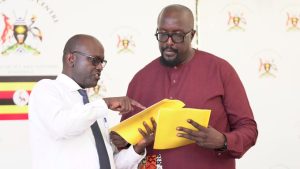
“The office has continued supporting the Government communication function and coordination with the media to ensure wide dissemination of Government information,” said Katureebe.
He noted that more than 200 media and communication initiatives had been supported over the past year, while engagement across print, broadcast, and online platforms had significantly expanded.
However, he pointed to resource constraints. “Uganda Media Centre is provided with UGX 1.36 billion for a financial year, which isn’t sufficient for capital expenditure, like acquisition of vehicles and media equipment,” Katureebe said.
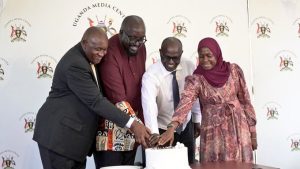
Formally handing over the office, he added: “It is with profound gratitude that I hand over the office of the Executive Director to my senior colleague, Mr Alan Kasujja.”
Government backs appointment
The Minister for ICT and National Guidance, Chris Baryomunsi, welcomed the appointment, expressing confidence in Kasujja’s leadership. “His appointment marks a new chapter in strengthening government communication and public engagement in the digital era,” Baryomunsi said.
He added that the new policy direction requires harmonised messaging across government. “Uganda Media Centre is positioned to ensure the government speaks with one clear, coordinated and credible voice.”
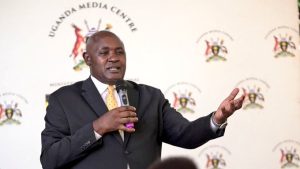
Permanent Secretary at the Ministry of ICT and National Guidance, Aminah Zawedde, underscored the strategic importance of the institution.
“Effective government communication must be timely, credible, and coherent,” Zawedde said. “Uganda Media Centre plays a central role in ensuring the government speaks with one voice in an evolving information space.”
She also paid tribute to Opondo for his 13 years of service and commended Katureebe for steering the institution through the transition period.