


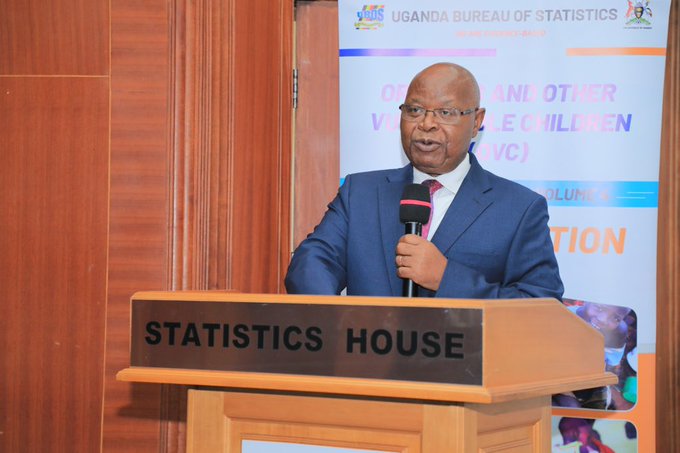
The Uganda Bureau of Statistics (UBOS) has disseminated the 2024 Orphans and Other Vulnerable Children (OVC) Census Monograph, providing critical data to guide child welfare policies and development interventions.
The dissemination took place on Thursday, March 19, 2026, at Statistics House in Kampala.
Speaking at the opening ceremony, UBOS Executive Director Dr Chris Mukiza emphasised the significance of the report in shaping evidence-based policies. “The Orphans and Other Vulnerable Children (OVC) Census Monograph 2024 – Volume 4 avails critical current indicators to lessen the challenging burden of orphanage, child-headed families and resultant vulnerabilities such as increasing school dropouts, early pregnancies, and early marriages,” he said.
Dr Mukiza acknowledged the strategic support of UNICEF Uganda in the dissemination of the report, as well as the Ministry of Finance, Planning and Economic Development for funding 97% of the 2024 Census. “This monumental effort contributes to the repository of national data and reinforces our commitment to statistical integrity,” he added.
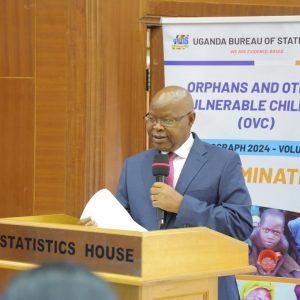
The Monograph, drawn from the 2024 National Population and Housing Census (NPHC), provides insights into over 22.2 million children under 18, representing more than half of Uganda’s population. The report highlights equal gender representation with a sex ratio of 100, indicating a balanced number of males and females among children.
The Bureau has previously disseminated the Sub-Regional Area Profiles – Volume 2 and the Disability Monograph – Volume 3, both generated from Census 2024 data. These publications provide detailed, sector-specific insights to inform planning and interventions.
The development of these monographs is demand-driven, designed to provide key indicators for addressing gaps, guiding remedial initiatives, and responding to emerging challenges across sectors.
Highlighting the practical importance of the findings, Dr Mukiza called on policymakers, civil society, and other stakeholders to leverage the data for program design and decision-making.
“As we disseminate these findings, I urge all stakeholders to utilise the data to strengthen policies, programmes, and interventions for Orphans and Other Vulnerable Children, ensuring they are fully included in Uganda’s economic development,” he said.
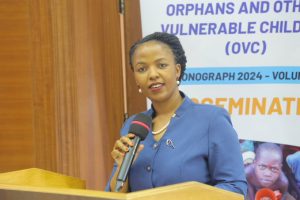
In her remarks on behalf of the UBOS Board Chairperson, Dr Allen Kabagenyi, emphasised that reliable data is a strategic national asset. “Data is not just a collection of numbers, but a critical tool for informed decision-making and national development,” she said.
The OVC Census Monograph is the fourth in a series of reports derived from the 2024 Census, following the Sub-Regional Area Profiles and the Disability Monograph. It is designed to provide sector-specific indicators that inform targeted interventions, policy formulation, and programs aimed at improving the welfare and protection of Uganda’s most vulnerable children.
The dissemination of this report marks a significant step in evidence-based planning, strengthening child welfare initiatives, and aligning national efforts with the Sustainable Development Goals.