


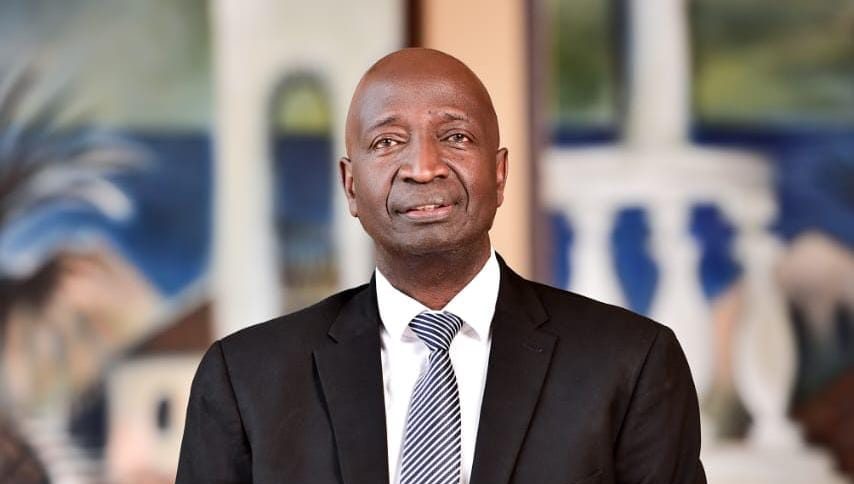
After ten years at the helm of the Petroleum Authority of Uganda (PAU), Ernest Rubondo, the institutional architect of Uganda’s oil sector, will step down in August 2026 when his contract expires, closing a defining chapter in Uganda’s oil and gas development.
The Authority advertised the chief executive position in December 2025, with applications closing on January 2, 2026, signaling a structured leadership transition.
Rubondo may depart before first oil, but after overseeing the regulatory and institutional architecture designed to deliver it.
He is one of the three original oil technocrats selected by President Yoweri Kaguta Museveni in 1986, to master petroleum geology, alongside Reuben Kashambuzi and Fred Kabagambe-Kaliisa.
The last of that cohort to exit the stage, Rubondo oversaw Uganda’s transition from oil discovery to the threshold of First Oil, expected in late 2026, while building the Petroleum Authority of Uganda from a skeletal office into a globally credible regulator.
Under his stewardship, PAU strengthened oversight of procurement, budgeting, and cost-recovery systems, with audits supervised by the Office of the Auditor General. The Authority maintains that Uganda’s petroleum projects position the country competitively within volatile energy markets.
Resource estimates also improved during Rubondo’s tenure. Total petroleum resources increased from 6.5 billion to 6.6 billion barrels, while recoverable volumes rose from 1.4 billion to 1.65 billion barrels. Rubondo attributed this growth to enhanced geological interpretation of the Albertine Graben basin.
Three mega-projects anchor Uganda’s upstream development: Kingfisher (CNOOC), Tilenga (TotalEnergies), and the East African Crude Oil Pipeline (EACOP). Combined, they represent investments of roughly $14–15 billion. By comparison, Karuma Hydropower, previously Uganda’s largest infrastructure investment, was valued at $1.6 billion, underscoring the scale of capital mobilized during his tenure.
The expansion has not been without scrutiny. Environmental concerns, cost management pressures, and social safeguards attracted global attention. Rubondo acknowledged both legitimate concerns and misinformation from anti-fossil fuel campaigners, maintaining that regulatory decisions were grounded in comprehensive environmental and social impact assessments.
Beyond domestic oversight, he led Uganda’s Petroleum Authority in expanding its international regulatory engagement, building partnerships across Norway, Ghana, Kenya, and Tanzania, and benchmarking Uganda’s framework against global standards through international platforms.
As Uganda approaches first oil, PAU enters a new phase: regulating field production, pipeline operations, refinery development, and downstream expansion, while strengthening linkages between oil and sectors such as transport, agriculture, tourism, health, and education. Rubondo estimates these linkages could unlock up to $8 billion in GDP growth even before peak production revenues materialize.
His defining legacy is institutional. Throughout his tenure, Rubondo emphasized building systems designed to outlast individuals, embedding governance, technical capacity, and regulatory discipline at the core of Uganda’s petroleum sector.
His successor will inherit a sector transitioning from preparation to execution under PAU’s 2026–2030 strategic plan, themed “Enabling a Sustainable Petroleum Industry” and a foundation grounded by Rubondo’s legacy in leadership in building and institutional scale.