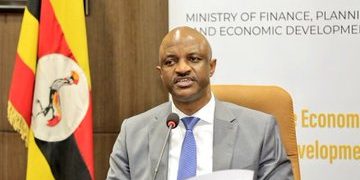



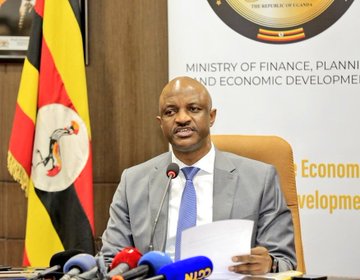
The Ministry of Finance, Planning and Economic Development (MoFPED) has released a pre-election economic and fiscal update, highlighting robust growth, macroeconomic stability, and strong public spending ahead of Uganda’s general elections scheduled for January 15, 2026.
The update, published on Monday in line with Section 18(1)(a) of the Public Finance Management Act (PFMA) Cap 171, shows that Uganda’s economy grew 6.3 percent in FY2024/25, driven by strong performance in industry, agriculture, and services.
“The Ugandan economy has exhibited immense resilience amidst rampant uncertainties in the global economy,” said Dr Ramathan Ggoobi, Permanent Secretary and Secretary to the Treasury.
“With stability preserved, economic growth is projected at 6.6 percent in FY2025/26, and is expected to strengthen to over 7 percent over the medium term.”
The report underscores that macroeconomic stability has been maintained through coordinated fiscal and monetary policies, keeping inflation within the five percent target and strengthening the Uganda Shilling against major currencies. Foreign exchange reserves rose to USD 4.98 billion by September 2025, up from USD 3.0 billion the previous year.
Sectoral Growth and Investment
Industry-led growth at 6.9 percent, while agriculture, forestry, and fishing grew 6.8 percent. Services expanded by 5.4 percent. Foreign direct investment hit USD 2.98 billion, largely from the oil and gas sector, while diaspora remittances increased to USD 1.57 billion. Tourism receipts also recovered to pre-COVID levels, totalling USD 1.57 billion.
The update also highlighted socio-economic transformation gains, including a drop in poverty to 16.1 percent and a reduction of households in the subsistence economy to 33.1 percent. Government programs like the Parish Development Model, Emyooga, and Uganda Development Bank capitalisation have contributed to these improvements.
Election Preparedness and Spending
Ahead of the 2026 elections, MoFPED confirmed that Shs 1,116.72 billion has been released to agencies responsible for election preparation, including: Electoral Commission: Shs 838.71 billion, Uganda Police Force: Shs 263.03 billion and Uganda Prisons Service: Shs 14.98 billion.
“We remain committed to further supporting the process to ensure smooth delivery of the general elections,” Dr Ggoobi said.
The Ministry noted that Shs 838.16 billion has already been spent on election-related activities, ensuring that voting and tallying processes are fully funded and operational.
Fiscal Performance
Despite strong growth, the report notes a fiscal deficit of Shs 4,159.41 billion in the first quarter of FY2025/26, higher than planned due to revenue shortfalls and increased spending on development projects. Government expenditure focused on economic growth and socio-economic transformation, including investments in agro-industrialisation, tourism, minerals, science and technology, infrastructure, and human capital development.
Outlook
The update signals that, despite global uncertainties from trade tensions and geopolitical risks, Uganda is positioned to maintain strong economic momentum, sustain private sector confidence, and support the electoral process.
“FY2025/26, despite being an election year, is pivotal for advancing our economic transformation agenda,” the report notes, emphasising ongoing efforts to expand Uganda’s economy from USD 61.99 billion to over USD 500 billion over the next fifteen years.
The full report is available on the Ministry of Finance website at www.finance.go.ug.