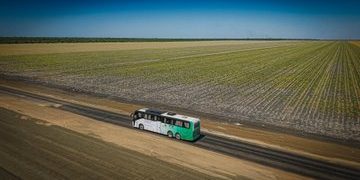



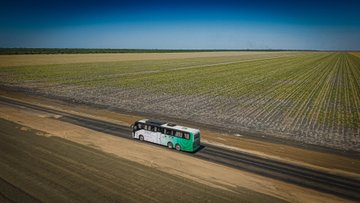
Gaborone, Botswana – Kiira Motors Corporation has successfully concluded the Botswana leg of its Made in Uganda Grand Trans-Africa Electric Expedition, marking a key milestone in demonstrating the endurance, efficiency, and regional relevance of African-built electric mobility.
The expedition first entered Botswana on 30 November 2025, exited on 3 December, then re-entered on 16 December, completing its final transit on 18 December, underscoring Botswana’s role as a strategic transit corridor within Southern Africa.
Traversing the country’s open savannahs and sparsely populated corridors, the Kayoola E-Coach underwent rigorous long-distance technical validation, covering varied operating conditions that highlighted its reliability for African realities, where long travel distances and limited charging infrastructure present significant challenges.
Stakeholder engagements were a core part of the journey. In Nata, the team interacted with students and educators at Nata Senior Secondary School, introducing them to electric mobility, sustainable transport, and Uganda’s advances in automotive engineering. The engagement emphasised the importance of nurturing future African innovators.
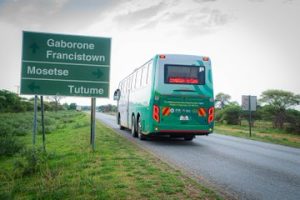
In Francistown, the expedition received a formal welcome at Cresta Thapama Hotel from a Ugandan delegation led by Ambassador Kintu Nyago, Deputy High Commissioner of Uganda to South Africa.
Ambassador Nyago described the expedition as “a defining milestone in Uganda’s industrial transformation,” highlighting the Kayoola E-Coach as a symbol of African innovation and leadership in green mobility.
The Botswana leg concluded in Gaborone with a Uganda–Botswana stakeholder engagement, bringing together government officials, private-sector leaders, technologists, and members of the Ugandan community. Discussions focused on industrial cooperation, e-mobility development, technology exchange, and scaling Ugandan innovations across Southern Africa.
By the end of this phase, the expedition had covered 10,085 km, representing 72.44% of the total Grand Trans-Africa route. Over this distance, the journey avoided 4,484.17 kg of CO₂ emissions while consuming 8,153.04 kWh of energy, averaging 0.81 kWh/km, validating both the environmental and operational benefits of the African-built electric vehicle.

Ambassador Nyago and the Kiira Motors team expressed gratitude to the Government of Uganda, H.E. Yoweri Kaguta Museveni, Hon. Dr Monica Musenero Masanza, and other institutions whose support made the expedition possible.
Strategic partners such as MTN Uganda provided digital infrastructure for real-time telematics and communications, while Britam Uganda ensured operational safety and risk mitigation.
The expedition crew of 50, drawn from Kiira Motors, the Science, Technology and Innovation Secretariat, MTN Uganda, Britam, Swangz Avenue, Buzz Group Africa, and cultural storytellers, maintained 16-hour workdays to showcase Uganda’s innovation, resilience, and cultural soft power across the continent.

Botswana stakeholders also highlighted the potential of African innovations. Ms Lesego Thamae, Deputy PS in Botswana’s Ministry of Communications and Innovation, noted the importance of supporting homegrown technologies, while Tirafalo Mponang, Chairperson of the Botswana Bus Operators Association, emphasised that rising fuel costs make e-mobility adoption vital for sustainable public transport systems.
The successful Botswana leg reinforces Kiira Motors’ mission of powering Africa’s green mobility revolution, combining industrial innovation, sustainability, and regional collaboration.