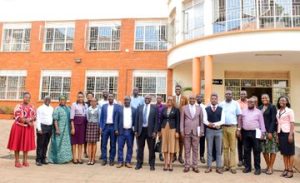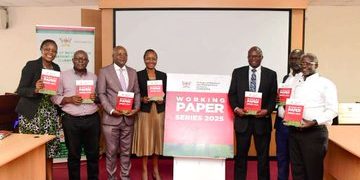



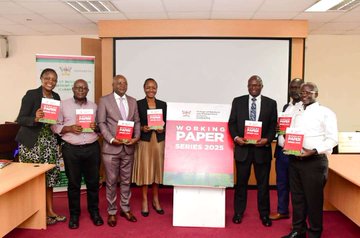
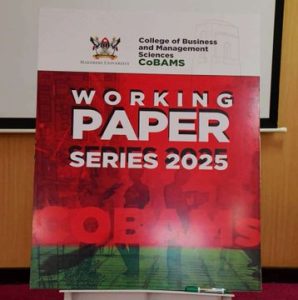
Makerere University has marked a major milestone in its research trajectory with the launch of the inaugural College of Business and Management Sciences (CoBAMS) Working Paper Series 2025.
Officiated by Acting Vice Chancellor and Deputy Vice Chancellor for Academic Affairs (DVCAA), Prof. Sarah Ssali, the launch showcased more than 60 research papers, many already accepted in internationally recognized journals.
The papers cover key national issues including unemployment, climate change, taxation, entrepreneurship, population dynamics, corruption, refugee livelihoods, and the green economy.
A landmark moment in the life of Makerere University
Prof. Ssali praised CoBAMS for demonstrating how a deliberate investment in research can transform scholarship at Makerere.
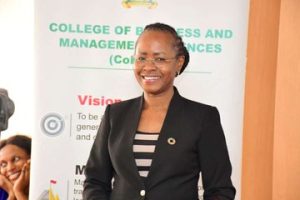
“Today is a landmark moment in the life of Makerere University,” she said. “This Working Paper Series is both a product and a symbol of our university’s strategic transformation.”
She noted that Makerere’s shift toward a research-intensive identity was intentional and is now yielding tangible results. “A few years ago, we made a bold and historic decision to reorient the University toward research and innovation. Today’s launch is evidence that this decision has taken root—especially within CoBAMS.”
She applauded the College’s decision to allocate a modest annual research grant to every faculty member, an initiative that produced over 60 papers in the 2024/2025 cycle. “This is a bountiful harvest by any standard,” she said. “It testifies to the commitment, rigor, and intellectual curiosity of our faculty.”
Prof. Ssali urged the College to go beyond working papers and invest in institutional journals. “If you can produce 60 papers this year and 80 next year, you have enough content for at least three journals. Journals raise our visibility and our H-index, and ensure that anyone researching Uganda finds homegrown scholarship.”
She also highlighted the need for rigorous research on key national challenges, including unemployment, elite overproduction, and informality. “Uganda’s economy grows, but unemployment remains high. When we celebrate entrepreneurship, we are often celebrating survival. These are questions this Series must help confront.”
She added that research must shape national discourse: “If people are hungry and unemployed, they will go to the streets. We cannot sit here speaking English and pretend these issues will disappear.”
A collective achievement
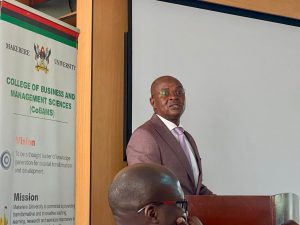
The Principal of CoBAMS, Prof. Edward Bbaale, described the Series as evidence of the College’s strong research culture.
“What we are celebrating today is the result of your collective effort,” he said. “This Working Paper Series is a nursery bed for journal articles, book chapters, and future scholarly outputs.”
He revealed that over 90 concepts were funded, and the College expects to produce more than 80 working papers in the 2025/2026 academic year.
Prof. Bbaale stressed that the College’s four research centers—in Entrepreneurship and Innovation, Statistics and Demography, Public Investment Management, and the Environment for Development Initiative—provide a solid foundation for knowledge creation.
“These centers anchor high-level research, policy engagement, and interdisciplinary collaboration. They are the backbone of our research ecosystem.”
He thanked the Acting Vice Chancellor for her support: “We are honored by your presence. Under your docket falls research, and we are grateful for the support you have continually offered Makerere and this College.”
This journey started with a modest grant
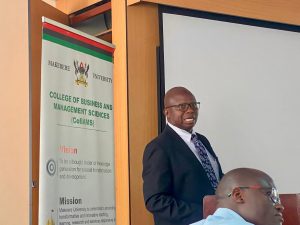
Associate Prof. James Wokadala, Deputy Principal, traced the Series’ origins to a small but transformative internal research grant introduced in November 2024. “This afternoon is a very important day for us,” he said. “This Series is the product of our internal efforts and internal resources.”
He explained that each paper underwent school-level presentations, editorial reviews, and harmonization before acceptance into the Series. “In total, about 90 concepts were funded. Today, we are launching six of those papers, with many more to follow.”
CoBAMS is a powerhouse of knowledge production
Dr. William Tayeebwa, Managing Editor of Makerere University Press, praised the scale and quality of research emerging from CoBAMS. “This is the first Working Paper Series of its kind at Makerere University,” he said. “CoBAMS is truly a powerhouse of knowledge production.”
He committed the Press to supporting the transformation of the papers into high-quality academic outputs. “We can convert these working papers into journal articles, special issues, and thematic book volumes within six months. The Press stands ready to support you.”
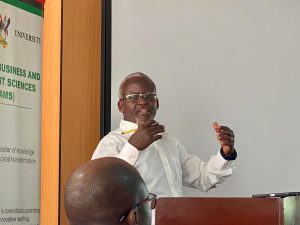
He noted the diversity of topics—refugees, Emyooga, malaria, corruption, tax compliance—as evidence of a rich intellectual base.
Strengthening peer support
Representing postgraduate students, Ms. Sylvia Namujjuzi, Assistant Lecturer and Vice President of the CoBAMS PhD Forum, underscored the importance of peer networks.
“The PhD journey can be lonely,” she said. “This Forum brings students from the three Schools together to network, share knowledge, organise seminars, and hold mock defences.”
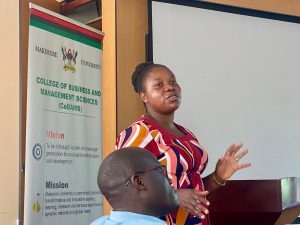
She added: “Our aim is to make the PhD journey smoother, less tiresome, and less lonely. Thank you to all students who made it here today.”
The Working Paper Series aligns with the UN SDGs, Uganda’s 10-fold National Economic Growth Strategy (ATMS), and Makerere’s 10-year Strategic Plan.
Prof. Ssali closed the launch with a call for continuity: “As Makerere University positions itself among leading research institutions globally, initiatives like this Series give concrete meaning to our strategic vision. May it grow, mature, and inspire a new generation of researchers.”