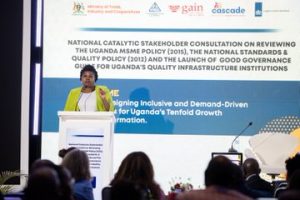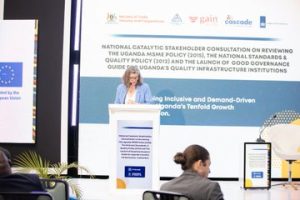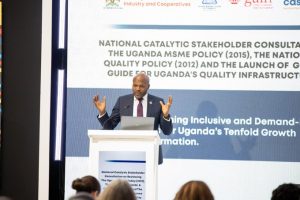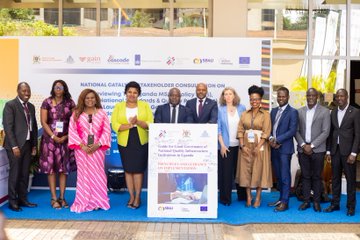
Uganda has begun the process of overhauling two of its most influential economic policies—the Micro, Small and Medium Enterprises (MSME) Policy (2015) and the National Standards & Quality Policy (2012)—during a national stakeholder consultation held on Tuesday at Four Points by Sheraton, Kampala.
The event also marked the official launch of the Good Governance Guide for Uganda’s National Quality Infrastructure (NQI) institutions.
Organised by the Ministry of Trade, Industry and Cooperatives (MTIC), in partnership with the European Union, GAIN, the International Trade Centre, the Kingdom of the Netherlands, and other development actors, the dialogue brought together policymakers, private sector representatives, and development partners to shape Uganda’s next decade of industrial and enterprise growth.

A Decade-Old Policy Framework Gets a Long-Awaited Update
Opening the consultation, the Minister of State for Trade, Hon. Wilson Mbadi—represented by MTIC Under Secretary Deogratius Masagazi—said updating the policies is crucial to the country’s long-term economic ambitions.
“Uganda’s economic future is clear: a $500 billion economy by 2040 through our Tenfold Growth Strategy,” said Hon. Mbadi. “Today, we launch the crucial review of our MSME and Quality Policies to turn this ambition into reality. The backbone of our economy depends on it.”
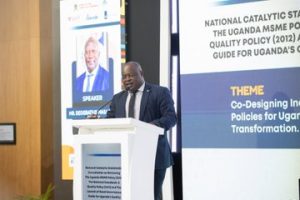
He emphasised that MSMEs, which constitute 98.8% of enterprises, contribute 75% of GDP and provide 77% of formal jobs, remain constrained by barriers in productivity, innovation, and certification. “MSMEs are not just part of our economy—they ARE our economy. It is time for policies that unlock their full potential.”
Good Governance Guide for Quality Infrastructure Launched
Hon. Mbadi also launched the Good Governance Guide for Uganda’s Quality Infrastructure Institutions, a framework designed to strengthen integrity, accountability, and performance in standards, metrology, testing, and accreditation systems.

“This framework ensures integrity, accountability and high performance—key for competitiveness, consumer protection and industrial transformation,” he noted.
Representing the Private Sector Foundation Uganda (PSFU), Board Vice Chair Ms Sarah Kagingo underscored the urgency of reform, citing challenges facing MSMEs.

“MSMEs are Uganda’s economy: 90% of the private sector, 75% of GDP, and over 2.5 million jobs,” Kagingo said. “But they face real barriers: costly capital, unreliable power, high data costs, and certification delays.”
She referenced a recent study that revealed manufacturing plants in Uganda operate at only 43% capacity, calling for targeted interventions to boost productivity. “Our major ask is simple: reduce product certification delays. Concerted action can unlock MSME potential.”

Development Partners Pledge Strong Support
The European Union’s Ambassador-designate, Frederieke Quispel, reaffirmed the EU’s commitment to supporting Uganda’s enterprise sector.
“The EU is investing €1.4 billion in Uganda’s private sector through the Team Europe ‘Sustainable Business for Uganda’ initiative,” she said. “EU-Uganda trade has nearly tripled since 2019—from €500 million to €1.4 billion. We are building on this momentum.”

She stressed the importance of a strong standards ecosystem in enabling export growth. “A transparent, reliable quality infrastructure is key to reducing trade barriers and ensuring Ugandan products reach global markets.”
GAIN Calls for Innovation and Digital Transformation
GAIN Country Director Damali Ssali highlighted the importance of innovation in enterprise growth. “Outdated policies slow growth, reduce competitiveness and limit quality,” she said.

“Our work with 300+ SMEs shows that with the right support in innovation, digital commerce and compliance, good intentions become tangible results.”
UNBS Executive Director Eng. James Kasigwa emphasised the role of standards and certification in global trade.

“National Quality Infrastructure isn’t bureaucratic—it’s the backbone of trade,” he said. “A product from China competes directly with one from Kampala. Our challenge isn’t resources—it’s quality.”
Patrick Mugisha, Commissioner for Business Development and Quality Assurance at MTIC, emphasised that the review is not merely an update, but a future-oriented redesign.

“Policy must be forward-looking,” he said. “We are integrating technology, including AI, to make this process more inclusive and to engage Uganda’s tech-savvy youth.”
He added that the newly launched Good Governance Guidelines will strengthen transparency and trust in the national quality system.

The consultations aim to align the reviewed policies with NDP IV, Vision 2040, and emerging shifts in regional and global trade, including the African Continental Free Trade Area (AfCFTA). The policy revision process will continue through national consultations, technical working groups, and private-sector dialogues in the coming months.