



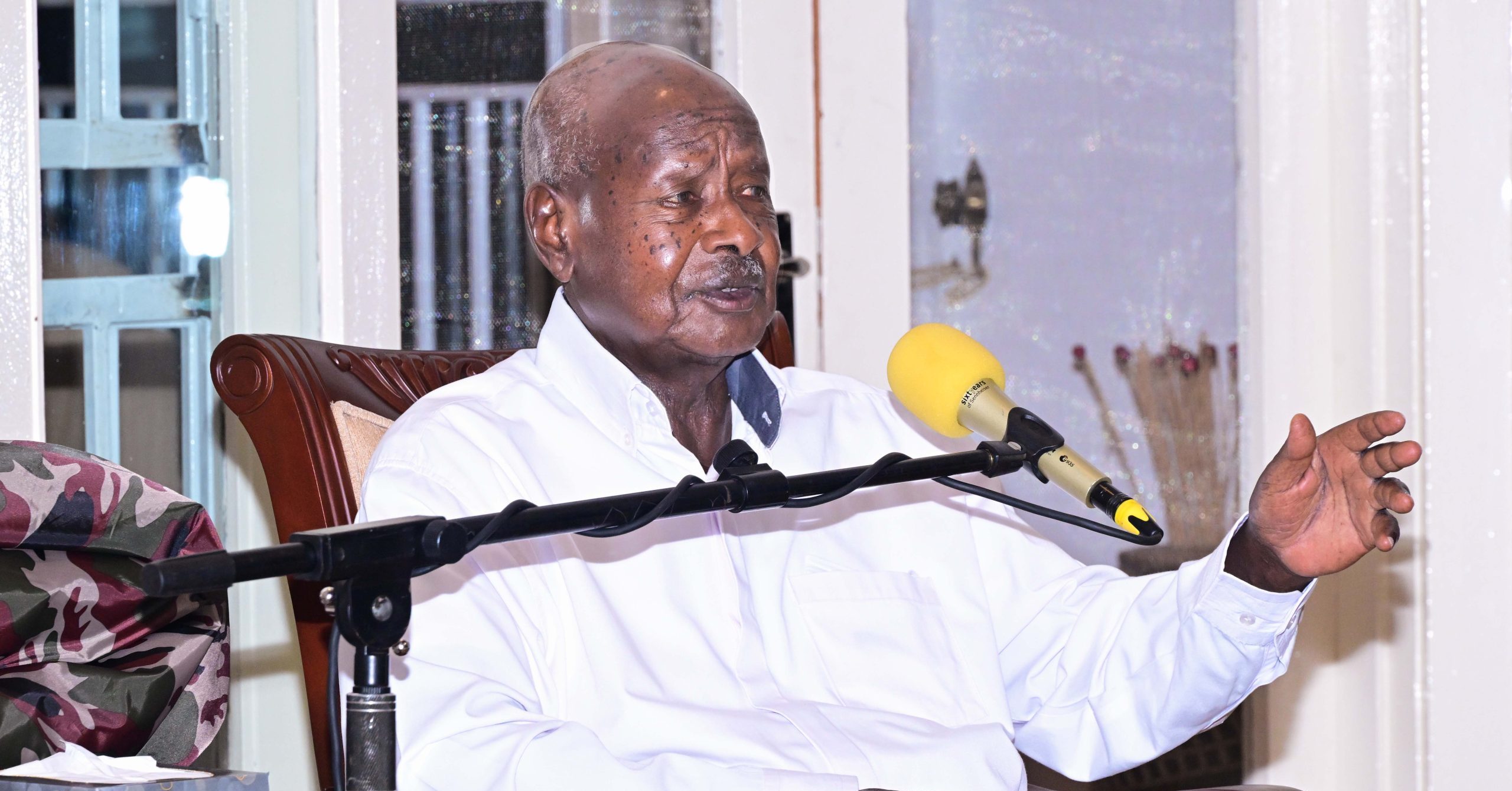
Mbale — President Yoweri Kaguta Museveni, on Friday, November 7, 2025, met with Mr Guang Cong, the United Nations Secretary-General’s Special Envoy for the Horn of Africa, at Mbale State Lodge.
The two leaders held in-depth discussions on regional security, the Nile River disputes, and broader geopolitical challenges affecting the Horn of Africa.
Mr Cong—appointed in July 2025 by UN Secretary-General António Guterres to succeed Ghana’s Hanna Serwaa Tetteh—expressed gratitude for the opportunity to engage President Museveni on key regional issues. He said his mission was to better understand the challenges in the Horn of Africa and identify how the United Nations could best support peace and stability efforts.
“I would love to hear from you about your assessment of the challenges facing the region and where you think the United Nations can add value to ongoing efforts,” Mr Cong said.
President Museveni, a long-time advocate of Pan-Africanism, told the envoy that instability in the Horn of Africa and other parts of the continent is largely rooted in what he called ideological bankruptcy and opportunism among political actors.
He said many conflicts stem from leaders who organise politics around identity—tribe, religion, or race—rather than addressing people’s material needs such as food, income, and peace. “Because they are ideologically bankrupt, they use politics of identity—tribe, religion, race—like in the case of Sudan. That’s how they broke it up, trying to emphasise Arabism and Islam on everyone when people were diverse,” the President explained.
Drawing parallels with Uganda’s own history, President Museveni noted that the country once struggled with sectarianism until the National Resistance Movement introduced an inclusive ideological framework in the 1960s.
He argued that weak leadership and divisive politics have prevented some African nations from building strong, self-reliant institutions such as national armies and police forces. “If you divide people into sectarian groups, you can’t form national political parties or institutions. That’s why some states depend on foreigners or the United Nations to defend them,” he said.
President Museveni also spoke about Africa’s cultural diversity, stressing that differences in belief or tradition should never be sources of conflict. He recalled a humorous exchange with former Sudanese leader Omar al-Bashir about food taboos to illustrate tolerance and mutual respect.
“I told Bashir that my list of haram is much longer than his. I don’t eat fish—I call it a snake. I don’t eat sheep or chicken because I believe it causes instability. But this is my culture, and I respect others who eat them,” he said, adding that mutual respect is key to peaceful coexistence.
He criticised extremist attitudes among some youth, saying, “Most Muslim youth are copying nonsense from the Middle East, judging others for what they eat. If someone eats pork, has he put it in your mouth? No. So how is it your problem?”
The President emphasised that Uganda’s interventions in regional conflicts—such as in Somalia—are motivated by Pan-African solidarity and self-reliance. “We intervened in Somalia to teach that Africa belongs to us, and whoever wants to be here must respect everyone. The problem is internal, worsened by foreign interference and Europeans supporting bogus groups,” he said.
On South Sudan, President Museveni said Uganda’s involvement has always aimed at preventing state collapse and regional instability. “This is the same problem of sectarianism—originally between Arabs and Africans, and now among African tribes themselves. Our position has been to stop a collapse because that would be a disaster,” he said.
He explained that Uganda has continued to advise South Sudan’s leaders—President Salva Kiir and Dr Riek Machar—to resolve their differences peacefully and through elections rather than violence. “The country belongs to the people. If you have disagreements, why not go for elections and let the people decide? Look at Kenya; they manage divisions through elections, not war,” he said.
Mr Cong also sought President Museveni’s perspective on the growing tensions between Egypt and Ethiopia over the Nile River.
In response, the President said that the real threat to the Nile was not political rivalry but environmental degradation and lack of socio-economic transformation across the basin.
“The danger to the Nile is the increasing population, which is poor and backward. They depend on biomass for cooking, cut forests, and destroy wetlands through primitive agriculture. If you care about the Nile, focus on transforming economies in the catchment areas,” he advised.
He cited environmental degradation as a major factor reducing the river’s flow, noting that the volume of water from Uganda to Sudan has fallen from about 60 billion cubic meters in 1964 to around 40 billion cubic meters today due to deforestation and reduced rainfall.
“Where has the 20 billion gone? It’s because of environmental destruction and less rain. That’s what people should be discussing,” he said.
President Museveni urged leaders to adopt a broader regional outlook, pointing out the vast potential of the Congo River. “You’re quarrelling about the Nile’s 85 billion cubic meters, yet the Congo River has 3,000 billion cubic meters. If there was peace, the water flowing into the ocean every minute would be enough for all of us,” he observed.
He concluded that Africa’s peace and prosperity depend on ideological clarity, unity, and leadership that prioritises citizens’ real needs over power struggles.
Mr Cong thanked the President for his insights and praised Uganda’s consistent role in regional peacebuilding. “Thank you, Your Excellency, for the opportunity to meet with you. I wish you and the people of Uganda a very successful election,” the UN envoy said.
Mr Cong, a Chinese diplomat with extensive experience in multilateral and regional affairs, assumed office in July 2025 as UN Special Envoy for the Horn of Africa. His mandate is to promote peace, stability, and cooperation in a region long affected by conflict, resource competition, and external interference.
The meeting was part of Uganda’s ongoing engagement with international partners to promote peace, stability, and socio-economic transformation across the Horn of Africa.